








8 benefits of knowledge management in healthcare



8 mins read
Healthcare organizations manage a large volume of information — policy documents, patient records, insurance details, and more.
When this information is scattered across multiple platforms, providers may have difficulty finding and accessing the resources they need.
Knowledge management is the practice of organizing all information in a secure digital platform, and it’s increasingly becoming the top information management solution for hospitals. Instead of wasting time searching for files, data, and reports, users can quickly access relevant information, share it internally, and discuss it with peers inside a healthcare knowledge management system.
In this post, we’ll look at seven key advantages of knowledge management in healthcare, how healthcare providers use these systems, and what to look for before investing in your own knowledge management system.
Why is knowledge management in healthcare important?
When healthcare professionals are able to share and access information about patients and treatments, they can greatly increase the accuracy of diagnoses and improve the continuum of care for patients. Yet, many healthcare organizations don’t have a secure platform for sharing this type of information. A knowledge management system fills that gap.
Knowledge management in healthcare increases efficiency, reduces the risk of errors, and improves communication across teams and organizations. An additional benefit of these systems is that they can help team members feel more connected, even when working in multiple different locations.
How can knowledge management systems benefit healthcare organizations?
Knowledge management systems have numerous benefits. In the field of healthcare, the following seven benefits provide the most value.
1. Knowledge management systems enable informed decision-making
Medicine is part science and part intuition, and doctors often make diagnoses based on their own experience and knowledge in healthcare. With a knowledge management system, healthcare providers have instant access to other providers’ notes, which greatly enhances the ability to make an accurate diagnosis and develop an effective treatment plan.
2. A knowledge management system in healthcare improves Internal Communications
Healthcare knowledgment platforms allow providers to share information about patient symptoms, treatments, and medical histories, without compromising doctor/patient confidentiality. Users can also communicate securely within the platform, via Slack, video calls, and direct messaging.
3. Knowledge management systems provide control and security
With SSL encryption, single sign-on, and ISO certification, healthcare knowledge management platforms protect sensitive patient and hospital information from unauthorized access. In addition, automated archiving ensures providers are always working with the most up-to-date information.
4. Knowledge management systems can help prevent medical malpractice
Hospitals can use knowledge management platforms to document their processes, share knowledge across teams and locations, and provide new training resources for providers. These capabilities may reduce the risk of medical malpractice.
5. Knowledge management systems support a culture of continious learning
In addition to sharing patient case histories, providers can share articles, research studies, and other information, and discuss these items within their knowledge management platform. In a sense, a knowledge management platform is similar to a social media platform, in that it allows users to share, comment on, and “like” posts, as well as tag other users.
6. Knowledge management systems help healthcare organizations keep up with changes in regulations and technology
It can be challenging for healthcare organizations to stay up-to-date with constant changes in industry regulations and technologies, from patient information privacy to new medical technology advancements. Knowledge management systems make it easy to share policy updates and manage important documentation from a centralized hub.
Administrators can set automatic email notifications to be sent to employees who have not read announcements, while keeping the in-app announcement pinned to the top of an employee’s news feed until it has been read.
7. Knowledge management systems enable healthcare digital information
Digital transformation means more than switching to paperless records — in healthcare, it means a fundamental change in how employees interact and manage their time. A knowledge management system improves collaboration and offers interactive features that can build morale among teams and organizations.
8. Knowledge management systems provide insightful user analytics
When you invest in a knowledge management system, you want some reassurance that employees are using it. In-app analytics can reveal user adoption rates, determine which content users find most valuable, and identify influencers within your organization.
Happeo helps healthcare organizations improve knowledge sharing and productivity
With the right software, healthcare organizations can increase efficiency, improve communication, and strengthen security. Happeo is the full-featured knowledge management platform that helps healthcare teams accomplish more, with features such as:
Workspace integrations: Happeo integrates with Microsoft Office and Google Workspace, allowing users to keep working with the systems they know.
Universal search capabilities: Find people, pages, scheduled meetings, files, and more with Happeo’s detailed Search Functionality.
Branded intranet pages: Happeo’s simple drag-and-drop editor lets administrators build branded Pages and customize login pages. You can also choose a custom URL, and apply your healthcare brand to notification emails.
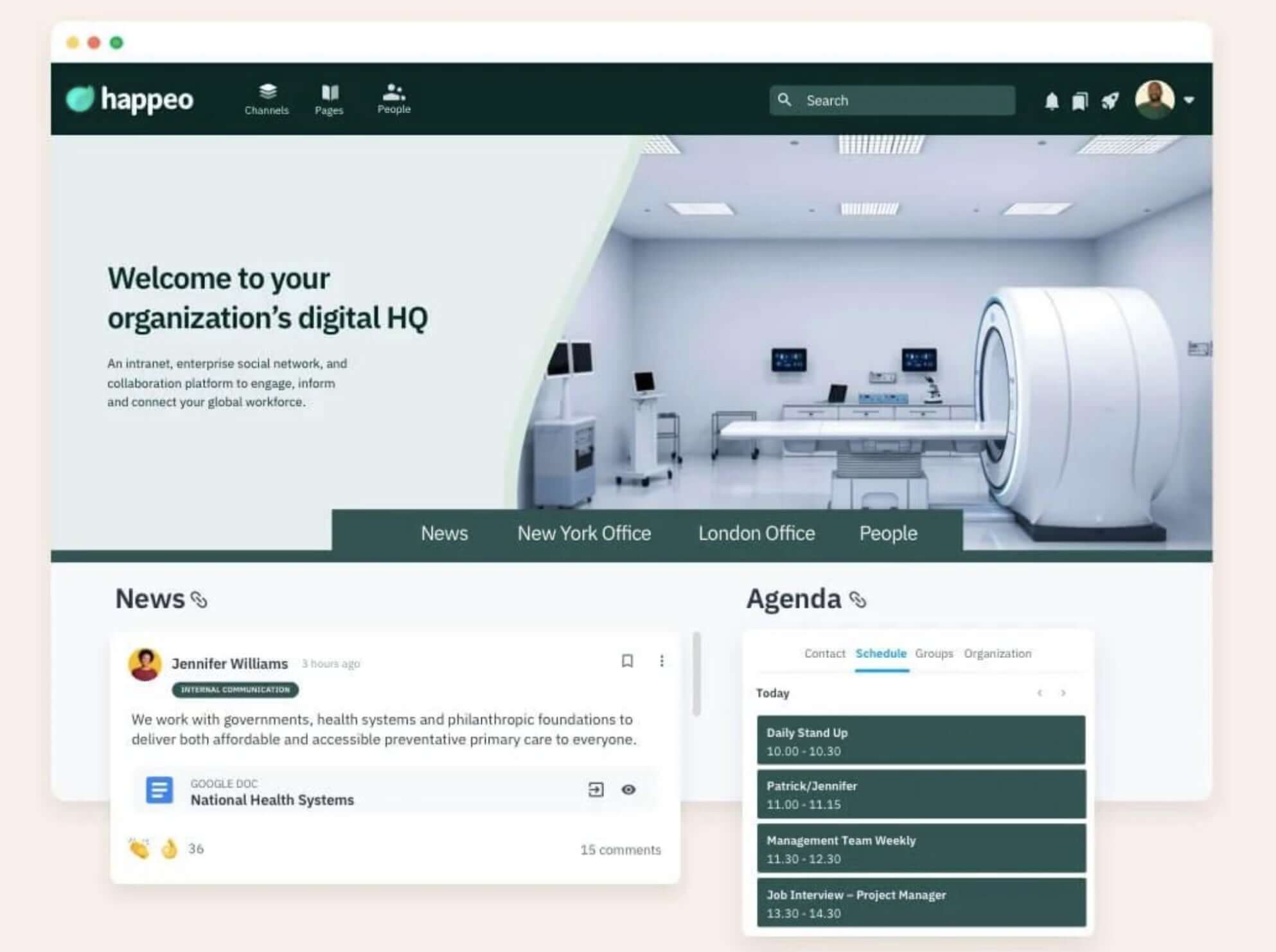
Image: Happeo Pages enable healthcare organizations to create custom pages with relevant dynamic content for each user, role, and function. No technical knowledge is required.
Internal Communications: Happeo integrates with Slack, Zoom, Jabber, WebEx, Google Meet, Google Calendar, and Microsoft Office calendars, enhancing communication and meeting planning. You can message people from within the platform, as well as make video calls.
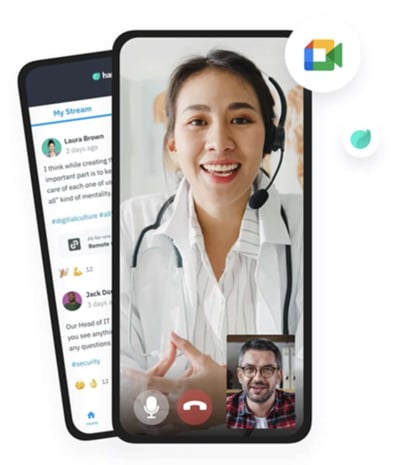
Image: Happeo brings office staff together with frontline workers. Healthcare professionals can quickly browse employee profiles, and then start a chat, video call or book a meeting.
Content lifecycle management: You can use Happeo’s automated lifecycle management feature to set expiration dates for content and receive alerts when content is about to expire. This feature is especially useful for ensuring you’re in compliance with annual privacy policy notices.
Advanced content and user analytics: Learn how teams are using and interacting with Happeo by reviewing your in-platform Analytics. You can review metrics such as activity by channel, by page, by user group, and other factors.
Secure sharing and collaboration: Happeo’s platform makes it easy to share sensitive patient data and other information, protecting it from unauthorized access. Leadership can use the platform to share special announcements and encourage employee engagement, and users can create their own personalized timelines that show only the news that’s most relevant for them.
Closing thoughts
Introducing new software across an organization can be a challenge, but Happeo’s user-friendly interface and social elements help healthcare professionals feel comfortable as they get to know their new knowledge management system.
At a time when hospitals are managing more data than ever before — and with the ever-present risk of data breaches — secure knowledge management systems offer peace of mind. Providers can share and learn from patient records, enhancing the overall quality and efficiency of care.
See how Happeo is helping healthcare providers improve their processes. Sign up for your free demo today.
How does a knowledge management system secure sensitive healthcare data?A knowledge management system protects sensitive patient and hospital information through robust digital security features. These platforms are designed to prevent unauthorised access and maintain patient confidentiality while still allowing healthcare providers to share critical clinical information. They achieve this by utilising advanced security measures, such as SSL encryption, single sign-on (SSO) credentials, and ISO certification. These standards ensure that only authorised personnel can access files, keeping doctor-patient confidentiality completely intact.
Beyond external security threats, keeping data secure also means keeping it accurate and controlled. Healthcare knowledge management platforms feature automated archiving, which ensures that medical providers are always working with the most up-to-date policy documents and clinical guidelines. This prevents outdated procedures from being used, which reduces the risk of critical medical errors and protects the entire organisation from potential medical malpractice claims.
Furthermore, secure collaboration tools are built directly into these platforms. Healthcare teams can safely discuss patient symptoms, treatment histories, and case studies. They can use integrated communication channels, such as secure direct messaging, Slack, or video calls, all without leaving the protected environment of the platform. By centralising these interactions, organisations prevent sensitive patient details from being shared over unsecured external channels, thereby maintaining high standards of data privacy.
How can healthcare organisations use a knowledge management platform to manage regulatory compliance?Healthcare organisations can use a knowledge management platform to stay up-to-date with constant changes in industry regulations, patient privacy laws, and medical technologies. By centralising all policy documents and important documentation in a single hub, administrators can ensure that staff always have access to the latest compliance guidelines. When regulations change, updates can be published instantly across the entire digital platform, removing the confusion that comes from scattered, outdated files.
To guarantee that crucial regulatory updates are seen by everyone, the system provides powerful internal communication features. Administrators can post announcements and pin them to the top of employees’ news feeds. These announcements remain pinned until they are read by the user. If an employee misses an update, the platform can automatically send email notifications to remind them, helping the organisation maintain compliance across multiple locations.
In addition to active communication, the platform supports compliance through automated content lifecycle management. Administrators can set specific expiration dates for policies, receiving alerts when a document is about to expire. This feature is especially useful for ensuring the organisation complies with annual privacy policy notices and updated safety standards. Combined with in-app analytics that track which employees have accessed the files, these platforms provide clear oversight of compliance activities.
What key features should be included in a healthcare knowledge management platform?A healthcare knowledge management platform should include robust workspace integrations that allow staff to connect with systems they already know. This includes compatibility with Google Workspace and Microsoft Office, alongside communication tools like Slack, Zoom, Google Meet, and WebEx. By linking these services, healthcare professionals can easily message colleagues, schedule meetings, and make video calls directly within the portal. This brings office staff and frontline physicians together into a single, cohesive network.
Another essential feature is universal search capability, which allows users to find files, pages, scheduled meetings, and employee profiles instantly. This is crucial in a fast-paced medical environment where finding patient records or policy documents quickly is vital. The system should also offer branded, customisable intranet pages. With simple drag-and-drop editors, administrators can design pages featuring dynamic content tailored to specific roles, without needing any technical or coding knowledge.
Finally, organisations should look for advanced content lifecycle management and in-depth user analytics. Lifecycle tools allow administrators to set expiration dates on content, ensuring that staff do not rely on outdated medical guidelines. Meanwhile, detailed platform analytics allow management to measure user adoption rates. By reviewing metrics like activity by channel, page, or group, administrators can see which content is most valuable, helping to continuously improve internal communications and knowledge sharing.
