






Building a business case for a financial services intranet



5 mins read


Product
Features
Happeo AI
Solutions
Happeo for
Use cases
Comparison
Resources
Explore
Support
Available now

Happeo For
Use cases
Comparisons
Explore
Support
Recent
Admin
5 mins read
Financial services companies face a specific tension: regulations often require storing years of transaction records and customer communications, while employees need to retrieve that information instantly and IT needs to keep it secure from breaches. A modern, cloud-based intranet resolves this directly — it centralizes records behind strict access controls while making search fast enough that compliance and usability stop competing with each other.
This isn't the clunky, on-premise intranet of a decade ago. A well-designed cloud intranet acts as a single source of truth for the organization, while also giving distributed teams a way to collaborate and stay connected.
An intranet investment pays off in five concrete ways for financial institutions specifically.
It supports the shift to hybrid and remote work. Financial services has historically been slow to adopt remote-friendly tools, but the pandemic forced the shift, and most institutions have no plans to fully reverse it. A cloud intranet gives distributed employees a shared place to collaborate, communicate, and stay connected regardless of location.
It reduces the risk of incorrect or outdated information. Files saved on local desktops and passed around as email attachments create confusion fast — messages get lost, and employees duplicate work chasing the "right" version. An intranet syncs documents to the cloud automatically, so colleagues work from the same current version instead of searching through downloads folders.
It enables compliance with industry standards and regulations. The average financial services employee has access to roughly 11 million files from their first day on the job, which is a significant security exposure on its own. A modern intranet lets you set granular permissions controlling exactly who can see, create, and manage specific content, making governance straightforward rather than an afterthought.
It increases employee productivity. Every minute spent searching for a document is a minute not spent on actual work. An intranet puts everything employees need in one central, easy-to-search location.
It improves employee engagement. Remote and hybrid employees often feel disconnected from company culture. A well-built intranet gives that culture somewhere to actually live and spread, rather than relying on incidental office interactions that no longer happen as often.
Not every intranet platform is built to handle the specific demands of financial services. Here's what to evaluate.
Secure and compliant knowledge management. Look specifically for ISO 27001 certification — an external audit confirming a provider's security processes meet strict international standards, rather than a self-reported claim.
Universal search capabilities. Financial services employees frequently need records that may be years old. A platform with strong universal search lets employees find what they need whether it lives on the intranet, in a shared drive, or on a local desktop, instead of hunting through each system separately.
Strict governance controls. Choose a platform that lets you set custom permissions down to the individual page, channel, or piece of content — ideally with the ability to base those permissions on existing Google Groups so access management doesn't become a manual, ongoing task.
A searchable employee directory. As more of the workforce goes remote or hybrid, a comprehensive directory searchable by name, role, email, or location becomes essential simply for employees to know who they're working with.
Content lifecycle management. Look for a platform that flags pages as they go stale and can automatically archive outdated content, since manually auditing a large knowledge base for accuracy isn't realistic at scale.
Internal communications tools. Segmented channels for company-wide news versus specific teams or departments keep communications targeted rather than overwhelming, with reactions and read receipts confirming messages actually land.
Social collaboration features. Channels aren't only for official business — spaces for informal team connection matter for combating the isolation that remote and hybrid employees often report.
Personalized home pages. A platform that lets employees customize their own home page and news feed reduces clutter and keeps the most relevant information front and center for each person.
Content and user analytics. Analytics showing active users and how specific channels or pages are performing let you actually verify whether the intranet is working, rather than assuming it is.
Happeo is built to balance the two priorities financial institutions have to hold at once: fast access to information and strict security.
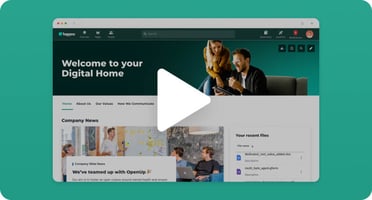
Happeo's people directory and auto-generated org chart help remote employees understand who their colleagues are and how the organization fits together, while collaborative Channels give teams a space to communicate and share ideas. Universal Search means employees are never more than a few clicks from what they need, replacing the old routine of hunting through email attachments to find the most current version of a file.
Happeo is ISO 27001 certified, meaning its security processes, people, and technology have been externally audited against strict international standards. On the implementation side, Happeo's typical ramp-up time is 6 to 8 weeks, which is fast relative to the industry average.
Book a free, personalized demo to see how it fits your organization.
Financial services firms have to reconcile strict regulatory requirements to retain records for years with employees needing to retrieve that information instantly. A modern cloud intranet resolves this by securely storing data behind granular permissions while still making it fast to search, and it also supports the hybrid and remote work models the industry has increasingly adopted since the pandemic.
The average financial services employee has access to roughly 11 million files from their first day on the job, which is a significant security exposure without proper controls. A modern intranet addresses this through granular permissions governing who can see, create, and manage content, combined with third-party certifications like ISO 27001 that verify security processes meet strict international standards.
The most important features are secure and compliant knowledge management (ideally ISO 27001 certified), universal search across multiple storage locations, granular governance controls, a searchable employee directory, and content lifecycle management that flags or archives outdated pages automatically. Internal communications tools, social collaboration features, and usage analytics round out what a financial institution should evaluate.
How long does it typically take to launch a financial services intranet? Timelines vary by provider, but a fast, well-supported implementation can take as little as 6 to 8 weeks rather than the months a legacy, on-premise setup would require. Look for a provider offering structured onboarding and permission automation tied to your existing identity system, since that speeds up rollout without compromising the security controls financial services requires.
