







6 things employees need from Internal Communications


6 mins read


Product
Features
Happeo AI
Solutions
Happeo for
Use cases
Comparison
Resources
Explore
Support
Available now

Happeo For
Use cases
Comparisons
Explore
Support
Recent
Admin
6 mins read
You know it, and they know it. Your employees’ satisfaction and well being are a priority if you want your company to thrive. Ultimately, you want everyone to be joyful when coming to work. For that to happen, you need to understand what people want at their job. The very first thing that needs to be brought up when thinking of human relations, in general, is communication. In this article we explore 6 important things employees want from internal Communication. Let’s divide it into parts.
Communication is a two-way street where both the recipient and sender of a message have to participate. To successfully communicate, you need to be able to listen and express your opinions, however, recognizing and understanding emotions behind information is also important.
Effective business communication is essential for business growth and stability. Communicating effectively fosters a good working environment and helps to:
Watch video
When asked what employees want from internal communications the most, the answer that got the largest response rate was “to build a community”. Seeing a team’s communication and social interactions as a thing to systemize is likely a step in the wrong direction.
There are no concrete answers when it comes to building a community. This won’t be solved by a fancy office or good salaries - although feel free to add that to the mix - but it does, however, come from a place of genuine desire for your employees to connect and have their workplace feel like a part of their identity.
Life’s all about timing, and so is communication. Every single one of your employees wants to be able to manage their time as effectively as possible. A lot of information employees receive is irrelevant or merely unnecessary, which translates into full inboxes, cluttered intranets, and every communication channel being potentially ineffective. In turn, this results in not being able to manage time effectively.
Time management aims to enable employees to complete more tasks in a shorter period – determine what information needs to be shared and remove all unnecessary messages.
The way we communicate in the workplace has changed in recent years. We now use chat tools, instant messaging, emails or intranets. But despite new communication technology being used, miscommunication still frequently occurs and is a big part of our daily work lives.
The way you communicate is often more important than what you have to say, so keep your message short and consistent. Your employees will always favor simplified information that is needed, rather than being flooded with messages that, even if backed by the best of intentions, can very well end up being irrelevant.
Download feature list
Defining who does what in a team will guarantee less conflict and better collaboration, making teams more productive. Everyone in the workplace has specific priorities to be working on. Making these priorities clear to all and assigning team roles will cater for better accountability.
When done right, Internal Communications can encourage collaboration and employee engagement, thus, efficiently reaching your organizational goals, missions and values. How? This is by:
Employees are looking for less extrinsic and more intrinsic motivation. Intrinsically motivated employees will want to perform an activity, such as communicating, for their own sake and personal reward and satisfaction, rather than extrinsically be motivated, communicating to just earn a reward or avoid punishment. If they feel like they’re doing the latter, employee collaboration and engagement will not be as effective. Building a bridge between your talent’s relationships and the way they communicate is critical.
Building a bridge between your talent’s aspirations and the way they communicate is critical.
Last, but not least is sociability and trust. Do your employees trust each other, and how does this reflect on the way they communicate and socialize? Connecting the dots as to how people relate to each other, what type of information they share, and to whom are particular insights you should be looking at up close.
You could get valuable information to help create a simpler, happier, and more cohesive working environment by using the information that is presented to you.
Book a demo
If your communication doesn't revolve around the way your company is shaped, and how employees perceive it to be shaped, you're not creating alignment. You're creating dissonance.
Communication is meant to be a constant process, serving both the company and your employees in order for everyone to be a part of a whole.
No matter how much we end up systemizing processes in the company, communication in itself is complex and needs to be continuously updated. Being mindful of having a healthy-minded community is the pillar that unites them all. Be sure to build up from there, always keeping the happiness of your employees in mind.
If you’re a good storyteller, or someone comes to mind when thinking of this, do consider building a narrative around your company’s vision and mission. You might not be all suave when it comes to verbalizing the great ideas you have in mind for the company and everyone in the team, but a strong narrative could end up being your best ally.
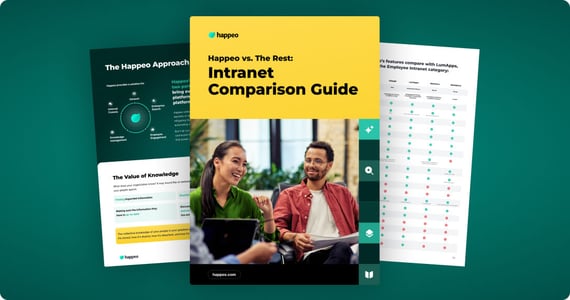
Communication is made easier by having the right intranet software. To find out which platform suits your needs, check out our intranet comparison guide. Happeo is the Google based intranet that employees actually love to use. You can book a personalized demo any time to find out more.
Employees most want internal communications that help build a genuine sense of community, along with clear, well-timed information, defined team roles, and meaningful opportunities for collaboration.
Effective communication improves employee engagement, eliminates communication silos, boosts productivity, reduces turnover, and drives employee advocacy, making it a key driver of business growth and stability.
Clear communication improves time management by cutting out irrelevant or unnecessary information, helping employees avoid cluttered inboxes and intranets so they can focus on completing tasks efficiently.
Trust between employees shapes how openly they communicate and collaborate, and understanding how people share information and relate to each other helps organizations build a simpler, happier, more cohesive work environment.
