








Posting' vs 'Chat messaging' in enterprise communication


5 mins read


Product
Features
Happeo AI
Solutions
Happeo for
Use cases
Comparison
Resources
Explore
Support
Available now

Happeo For
Use cases
Comparisons
Explore
Support
Recent
Admin
5 mins read
Internal communication has changed a lot during the past decade because of technology. There are several tools that make staying in touch easier than ever and the hardest part is choosing which tool to use. The amount of different tools also enable more ways to communicate.
We think 'Chat messaging' and 'Posting' are two unique communication methods and your enterprise needs them both!
"Ashley, will the presentation be ready in 30 minutes?", "Hi, John, do you have a moment for a quick chat?" and "Would anyone be ready for lunch now?"
'Chat messaging' is important and beneficial for organizations when communication is about quick matters that need immediate action.
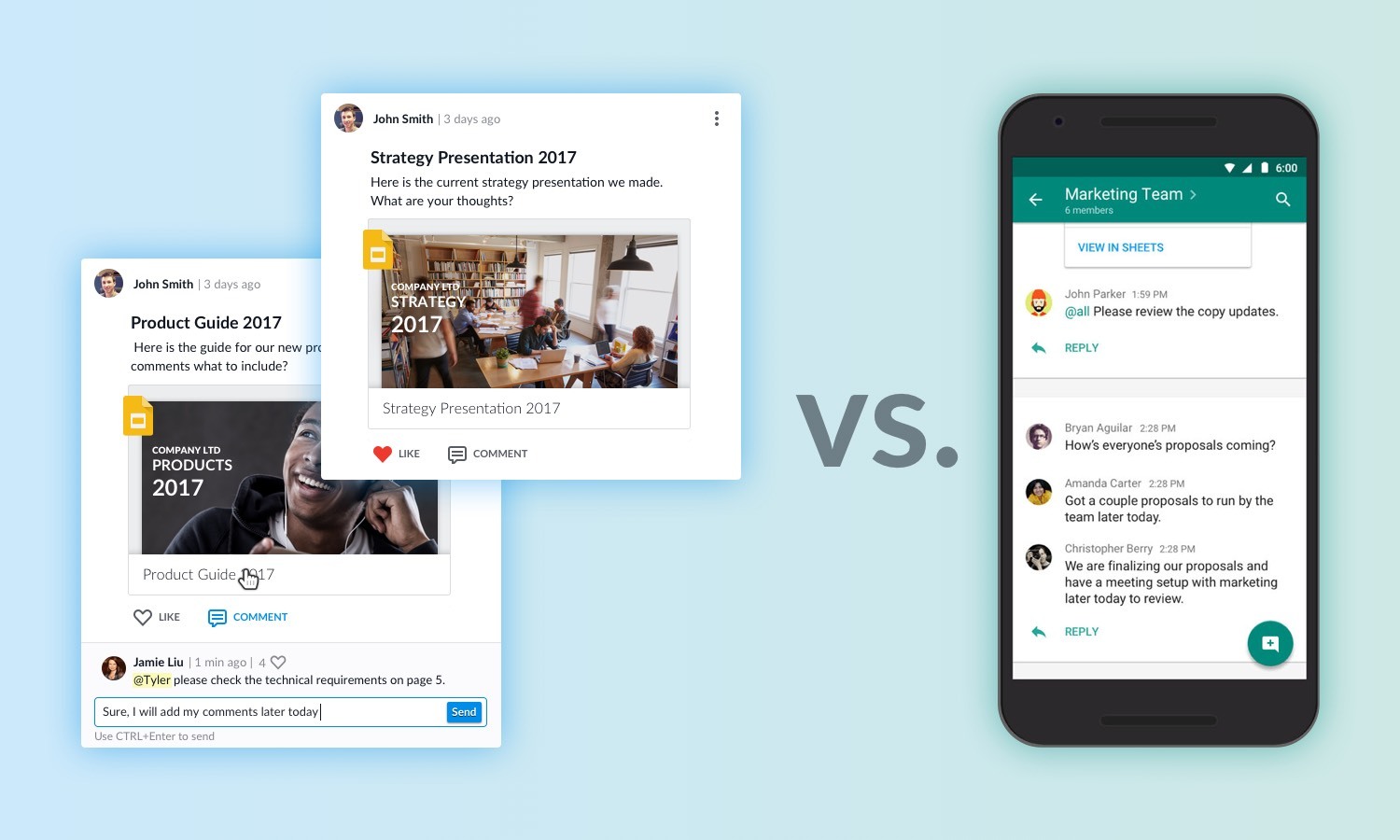
On the comparison, 'Posting' helps organizations in the decision making process about important matters that need more time to evaluate. For instance, "Here is the guide for our new product. Please tell us what to include." and "Sales team, can you post some best practices that have worked with your current clients?" are good examples of posting.
No organization can live without chat. It’s essential part of our communication. For topics that need immediate action chat is the king. Chat reduces the use of formal emails and thus makes communication faster.
However, chat tools make us also easily distracted from our most important matters - our daily work. Chat notifications break the flow of a work day. Topics in a chat conversation can easily inflate from the original topic to unrelated ones. Chats positive effect, the simplicity of sending messages, is also it’s burden. Chat rooms comes easily noisy and irrelevant. The larger the company grows more employees need to filter information.
Chat rooms have become our new email spam box with lots of junk.
In large enterprise many decisions are made through a discussion process that takes longer than a typical chat conversation. Posting, commenting and liking topics are good ways to facilitate the decision making process in a large group of people and everyone in the organization can feel involved with their own way.
Typically employees in large organizations are also discussing and collaborating from different time zones. “Posting” favors participation to a discussion from different time zones because people don’t expect to get answer immediately.
To keep everyone on track about the company updates large companies’ HR & Communications departments need to be clever in company top-down announcements. In this way of communication, posting wins over chat and email too. The noise of other messages within an email inbox and in chat threads gets the viewers attention easily. Thus, “Posting” in its own planned place gives the viewer clear place to follow top-down information. In this kind of space HR & Comms team are able to design, manage & track the announcements too.
We at Happeo focus on enterprise needs of communication and collaboration. Chat is an important part of communication and you can choose which chat tool works the best for you. However enterprises have additional needs on top of that. We believe that a truly Digital Workplace for enterprises is much more than a chat. It’s a place where you’ll find all your company’s relevant information and where you can collaborate with your colleagues easily and in the most efficient way possible.
‘Posting’ and ‘chat messaging’ are both essential in different ways for effective decision making process.
What are the main differences between chat messaging and posting in enterprise communication?Chat messaging and posting serve two entirely different communication purposes within a modern enterprise. Chat is designed specifically for quick, transactional interactions that require immediate action or rapid responses, such as asking if a presentation is ready or coordinating lunch. It excels at fast-paced, real-time conversations and successfully reduces the reliance on formal internal emails, making day-to-day office interactions incredibly quick and simple.
In contrast, posting is a structured communication method suited for important business matters that require thoughtful evaluation, deep discussion, and collaborative input over a longer period. It allows employees to share detailed updates, ask for feedback on complex documents, or share team best practices. Posting enables a structured feedback loop where colleagues can comment on and like topics, facilitating a transparent decision-making process where everyone feels involved.
Furthermore, posting is highly beneficial for global organizations operating across different time zones. Since there is no expectation of an immediate reply, employees can contribute to discussions at times that suit their schedules. This asynchronous nature prevents the urgent pressure associated with constant chat notifications. By utilising both methods, an organisation can balance the need for immediate, urgent updates with the need for deeper, strategic discussions that require time and collective input.
What are the negative side effects of relying solely on chat tools for company communication?Relying solely on chat tools can lead to severe communication fatigue, constant daily distractions, and a significant loss of productivity. Because chat notifications constantly interrupt employees throughout the workday, they break the natural flow of focused, deep work. The sheer simplicity of sending quick messages makes chat rooms incredibly noisy, meaning important updates are easily buried under an avalanche of casual remarks.
Additionally, conversations within a chat application can easily inflate and drift away from their original topics. A thread that started as a simple query can quickly expand into multiple unrelated discussions, making it extremely difficult for employees to track decisions or find relevant information later. As a company grows larger, its employees are forced to spend valuable time filtering through massive amounts of chat noise just to find what is important.
This overwhelming volume of messages essentially transforms active chat rooms into the digital equivalent of old email spam folders, cluttered with junk and irrelevant conversations. When an organisation lacks a dedicated space for long-form updates, critical announcements from leadership get lost in the constant stream of consciousness. This demonstrates why chat, despite its immense value for quick coordination, can become a major operational burden if it is not balanced with a structured posting system.
How does posting help HR and Communications teams manage top-down announcements?Posting provides HR and Communications departments with a dedicated, organised space to share critical company-wide updates without being drowned out by daily conversational noise. In a typical corporate environment, important top-down announcements sent via email or chat are easily lost. Chat streams move too quickly, and email inboxes are constantly flooded with other messages, which distracts employees and causes them to miss vital updates.
By utilising a structured posting system, internal communications professionals can publish announcements in a clearly planned, centralised space. This dedicated environment ensures that employees always know exactly where to go to find authoritative company information. This structure eliminates the chaos of conversational threads, allowing the workforce to consume corporate updates in a calm and focused manner, rather than stumbling across them in noisy chat channels.
Most importantly, this specialised posting space empowers HR and Communications teams to design, manage, and track their announcements effectively. They can see how employees interact with the content through comments and likes, giving them measurable insights into engagement. This level of control and analytics is impossible to achieve in standard chat rooms, making posting an indispensable tool for maintaining alignment, transparency, and a strong organisational culture across large enterprises.
