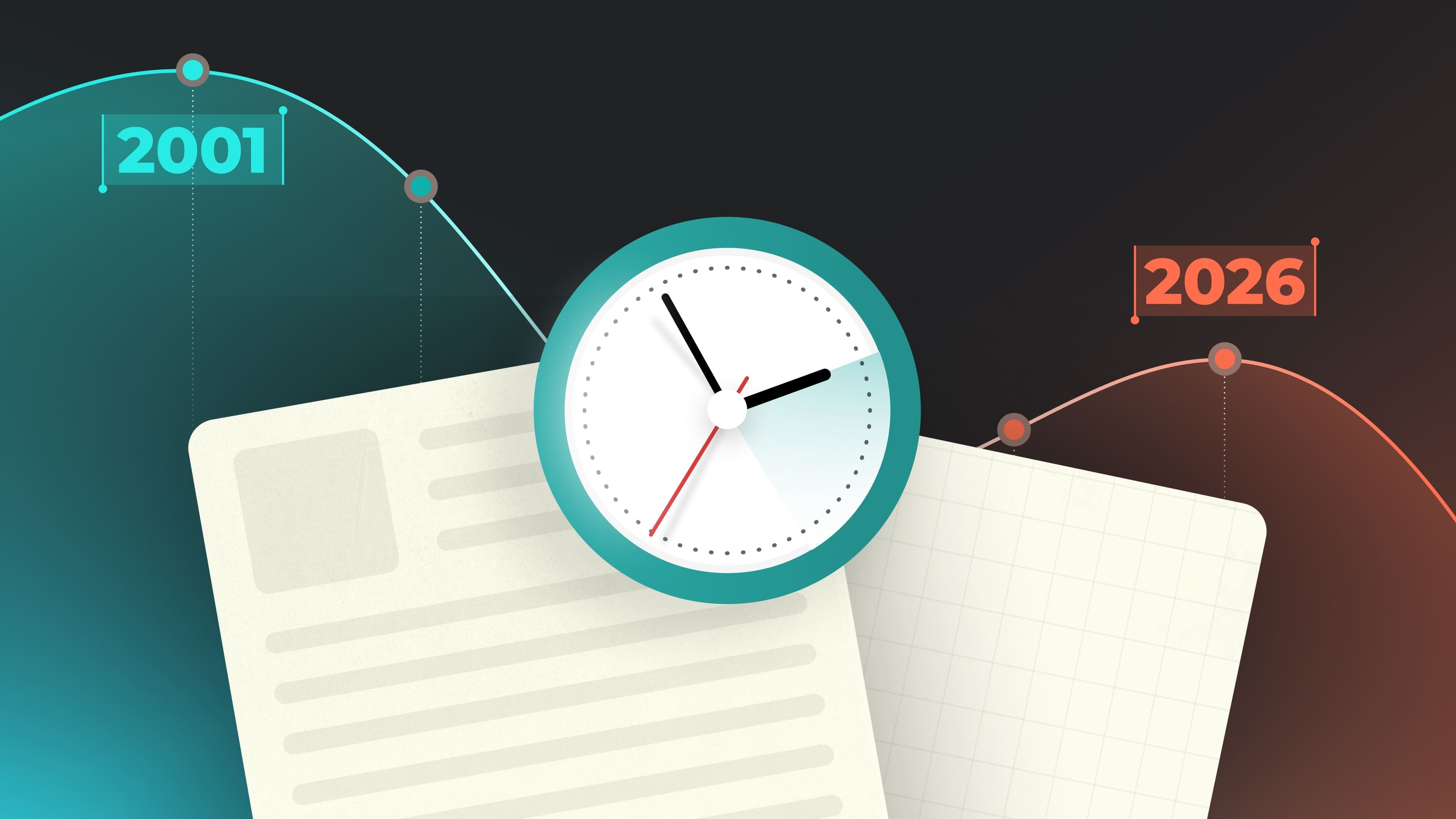
A trip back to 2001
You blink, and you’re back in 2001. Wikipedia had just debuted. Destiny’s Child was topping the charts with “Survivor”. Apple launched a tiny device called the iPod. And a young Tom Brady made his first professional start for the Patriots.
In the same year, SharePoint launched, and it was hailed as the future.
In 2001, information was produced at a relatively human pace. We wrote memos, published them to a static portal, and they stayed true for months. But the uncomfortable truth is that today, we are still using a quarter-century-old blueprint to solve our 2026 problems. “Central hubs” have become digital graveyards because they were built for a world that no longer exists. And try as they may, most intranets have failed to keep up to the quickly-evolving needs of the modern employee.
The divergence
There’s a disconnect between the reality of work and the tools that are supposed to facilitate it. Work has been “tech-ified”. Our daily output lives in fluid, breathing spaces; Google Docs are updated hourly and Slack threads capture decisions in real-time. But as our work became more fluid, the intranet stayed rigid.
This has created a significant gap. When the tool you’re supposed to trust is essentially a digital library from 2019, you stop visiting the library. You lose faith in the “official” word of the company.
We tried social, and it failed too
Ten years ago, the market thought the solution was making intranets social. We added likes, comments, and birthday notifications. While that may have helped cross-team visibility, it mostly added more noise.
A social intranet is just a louder version of a messy one if the knowledge quality isn’t addressed. If an employee can’t find the current expense policy in less than 60 seconds, they truly don’t care how many likes the CEO’s last post got. And they certainly don’t want to post to a channel and wait for an answer. Instead, they’ll go to Slack and interrupt a colleague instead. Social features by and large failed to add the one thing that actually matters: trust.
The real reason that social intranets failed is that we were solving for engagement when we should have been solving for accuracy. We assumed that if more people participated, knowledge would stay fresh. But what actually happened? The person who knows the answer is in back-to-back meetings. The person who responds first is confident but wrong. And six months later, that incorrect answer is still sitting there with 47 likes, looking authoritative.
The intranet’s theory of evolution
To understand where we are going, we have to look at where we’ve been:
- Intranet 1.0, aka the Filing Cabinet: Centralized but static. Hard to find information, harder to update it.
- Intranet 2.0, aka the Watercooler: The goal was engagement. It’s connected but noisy. Social features masked the fact that underlying data was decaying.
- Intranet 3.0, aka Speciation: This is Happeo’s vision. It’s the point where we build on our intranet foundations to support a wider knowledge mandate. It doesn’t only store information, but validates it. The goal is trust and findability.
What validation actually means
Validation isn't about adding approval workflows or creating content police. It's about building systems that treat knowledge as living, not static.
Let's get specific. When a product manager at a B2B SaaS company searches "enterprise discount structure," an 'Intranet 3.0' does more than just return the pricing deck from last quarter. It returns that deck with context: last updated January 15, owner is Sarah Chen in Revenue Ops, and here's a related company-wide Slack thread from last week where the CFO clarified a change. The system knows these things are connected because it's watching where work actually happens.
Or take onboarding. A traditional intranet gives new hires a benefits PDF and wishes them luck. An 'Intranet 3.0' system recognizes that "benefits" is actually answered across four different sources: the PDF for official policy, the FAQ doc that HR updates monthly, the Slack channel where people ask clarifying questions, and the recorded all-hands where the CEO announced the new parental leave policy. It surfaces all of them, ranked by freshness and relevance.
This is what we mean by validation: the system actively maintains the relationship between what's official, what's current, and what's actually being used.
The cost of doing nothing
The real question, then, is what obsolescence is costing you. Consider the compound effect: A new hire spends three hours trying to understand your benefits package because the information is scattered across five different places. A product manager makes a pricing decision based on a deck that's eight months old. A support team gives customers incorrect information because the knowledge base wasn't updated when the product changed last quarter.
These aren't edge cases. They're happening dozens of times a day across your organization. Each instance represents wasted time, frustrated employees, and missed opportunities. Scale that across a year, across your entire workforce, and you're looking at hundreds of thousands of dollars in lost productivity. More importantly, you're eroding the one thing that holds organizations together: shared truth.
The hidden advantage is the speed of truth
In 2026, your competitive advantage isn't just having the right information. It's having the right information faster than everyone else realizes it's changed.
When a regulation shifts, when a competitor pivots, when a customer need evolves, the companies that can update their collective understanding within hours, not weeks, are the ones that win. Intranet 3.0 is about knowing sooner, and making truth move at the speed of your business.
Think about it: your fastest employees are already working this way. They're in the right Slack channels, they have the right Google Docs bookmarked, they know who to ask. They've built their own personal knowledge graph. The question is: why should that be a competitive advantage held by individuals? Why isn't that the baseline for everyone in your organization?
We’re invalidating the status quo
Sticking with a legacy intranet or a chaotic social wiki is a business risk. Every time an employee acts on outdated information or spends twenty minutes hunting for a deck, your company loses velocity. Knowledge decay is a hidden tax.
At Happeo, we see the core function of the future workplace as “knowing the truth”. If your current system feels more like 2001 than 2026, you’re facing a growth and productivity problem. It’s time to bury the digital graveyard and start building a system that lives at the speed of your business.