







Digital Agency and Intranet: How Agencies Design, Build, and Evolve Modern Internal Platforms




Sophia Yaziji
11 mins read
Since around 2015, organizations have increasingly turned to digital agencies to transform aging intranets into modern digital workplaces. The shift accelerated as cloud adoption grew and mobile-first workforces demanded better internal tools. A 2015 Gartner report found that only 13% of organizations had intranets employees actually used—prompting IT and communications leaders to seek external expertise in UX design and modern content management.
This article is for marketing, IT, HR, and communications leaders looking to partner with a digital agency on an intranet project in 2026. You will learn what intranets are, how they fit into the broader digital workplace, and the specific value a digital agency can add at each stage—from strategy and UX to technology, content, and change management.
If you recognize scenarios like a SharePoint intranet from 2012 that no one uses, or multiple departmental portals launched between 2018–2022 with no unified experience, you are not alone. These fragmented systems create silos, frustrate employees, and fail to deliver the up to date information teams need.
“Modern intranets deliver 3x ROI by cutting search time and boosting engagement, per Forrester—agencies make this achievable.”
Intranet vs. digital workplace: where a digital agency fits in
Understanding the distinction between intranet and digital workplace is essential before engaging an agency. An intranet is a secure, internal-facing website for controlled content like policies, company news, and employee handbooks. The digital workplace, by contrast, encompasses the full ecosystem of tools employees use daily—Microsoft Teams, Slack, M365, Google Workspace, HR systems like Workday, and service desks like ServiceNow.
Consider these key differences: the intranet serves as a hub for news, documents, and policies with version control and compliance requirements. The digital workplace includes real-time collaboration via chat, video, and line-of-business applications. In practice, the intranet often becomes the “front door” into this broader ecosystem—a navigation and integration layer rather than just another tool.
Early 2000s intranets were static document repositories with poor navigation. By 2024, they evolved into AI-enhanced hubs integrated within broader digital workplaces, per Gartner’s Magic Quadrant for Digital Experience Platforms. A digital agency helps map this ecosystem, identifying silos like separate HR and IT portals, then architecting the intranet to provide a unified platform with single-pane views.
Think of it as a diagram with the intranet at the center, connected by spokes to HR (payslips), CRM (Salesforce dashboards), and communication channels (Viva Engage). A 2025 IDC study found organizations with agency-led ecosystem mappings saw 25% higher employee satisfaction scores due to reduced app-switching.
What is a modern intranet in 2026?
A modern intranet in 2026 is a cloud-native, mobile-optimized platform delivering personalized experiences integrated with enterprise systems. It has moved beyond static sites to become a proactive employee companion that helps people work efficiently.
Core features include powerful search with semantic AI capabilities (achieving 85% accuracy per vendor benchmarks), role-based dashboards where warehouse workers see shift schedules while managers view analytics, and generative AI recommendations surfacing relevant content. Social features like comments and likes foster internal collaboration, while deep integrations pull contextual data from M365, Google Workspace, Workday, ServiceNow, and Salesforce.
Most new intranet builds leverage SharePoint Online (commanding roughly 50% market share per Gartner 2026), dedicated platforms like MangoApps or LumApps, or custom React/Vue front ends calling APIs from existing systems. Analytics are now standard expectations—platforms track page views, search success rates (aiming for 80%+ resolution), content performance by date range, and user behavior heatmaps.
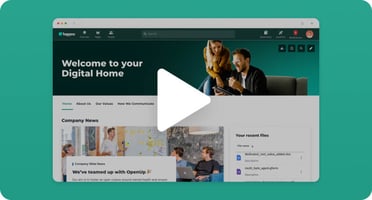
A typical 2026 homepage layout features a hero banner for CEO announcements, a personalized news feed filtered by department, quick links to forms and FAQs, an app launcher for Teams and Outlook, and widgets like “my tasks” or regional weather for distributed teams. This user experience delivers engaged employees who can find what they need instantly.
Why organizations still invest in intranets (and not just chat apps)
Despite the ubiquity of Teams, Slack, and email, organizations continue investing in intranets because they need a single source of truth for durable content. A 2025 McKinsey report estimated intranets reduce compliance risks by 35% through centralized policy publishing—for example, HR policies updated in January 2026 can be auto-distributed regionally with read receipts.
Key business drivers include:
|
Driver |
Business Impact |
|---|---|
|
Compliance and policy publishing |
Centralized updates across all regions with audit trails |
|
Employee onboarding hubs |
Cuts new hire ramp-up from 4 weeks to 2 |
|
Organization-wide news |
Multilingual support boosts comprehension 28% |
|
Forms and internal workflows |
ServiceNow integration resolves 70% of tickets via self-serve |
|
Knowledge management bases |
Reduces support queries by 50% |
Chat and email falter on information decay—90% of chat history goes ignored after 30 days, per Slack data, and Teams search yields less than 60% success. There is no content ownership, no approval workflows, and no official version control.
Agencies help quantify value through pre/post metrics: 30-50% email reduction, 1-2 hours weekly saved on document searches, and 20%+ engagement lifts in surveys. Expert design with proper governance prevents content bloat, making intranets enduring investments that boost productivity for the entire organization.
How a digital agency approaches an intranet project
A typical agency-led intranet project runs 12–24 weeks for organizations with 500–5,000 employees. Agencies compress timelines through agile sprints and pre-built components, but careful planning remains essential.
Discovery and research (4–6 weeks) involves 20–50 stakeholder interviews, employee surveys targeting 200+ responses from frontline and desk workers, content audits that typically cull 60% of obsolete pages, and analytics dives into existing usage patterns like top search failures.
Strategy and information architecture (2–4 weeks) defines OKRs—for example, 75% adoption within 90 days—crafts sitemaps by week 4, and prioritizes content types (typically 40% news, 30% tools and resources).
UX and visual design (4–6 weeks) yields wireframes and Figma prototypes tested with 50 users, plus brand-aligned design systems that ensure responsive design across devices.
Technical implementation (6–10 weeks) involves platform selection, configuring SSO/MFA, building templates, and establishing integrations with multiple systems.
Content migration and creation (4–8 weeks, running parallel) rewrites 70% of legacy content through guided workshops and establishes document management standards.
Launch, training, and change management (2–4 weeks) pilots with 10% of users, runs editor bootcamps, and executes internal campaigns. By month 3, agencies typically deliver content migration playbooks and completed editor training. Throughout, agencies balance IT’s security requirements with HR and communications needs for easy access and intuitive editing.
Key intranet capabilities a digital agency will design for
Beyond platform choice, agencies focus on core capabilities that determine daily usefulness. These tools employees rely on must deliver real value from day one.
Content management requires intuitive WYSIWYG authoring, approval workflows that reduce publish time by 50%, templates for consistency, and version control with audit trails. Content owners need to create and manage their own content without IT bottlenecks.
Search and navigation demands AI-powered suggestions, metadata filters, and prominent navigation patterns. Top platforms achieve 90% search success versus legacy systems’ 40%—a difference of hours saved weekly finding company information.
Personalization and targeting uses HR data as a source of truth to deliver content by role, department, and location. Role based access ensures warehouse workers see shift schedules while managers access analytics dashboards. This targeting lifts open rates by 35%.
Collaboration and community features include discussion forums, comments, likes, and spaces for different departments or projects. Social intranet elements drive 25% higher employee engagement.
Integration means surfacing information from HR systems, IT support, CRM, and project management tools in context. Surfacing ServiceNow tickets or Workday payslips within the intranet dashboard via Graph API pulls reduces clicks by 60%.
Mobile and offline access through PWAs or native apps achieves 80% adoption rates among frontline workers. A warehouse worker can scan a QR code for SOPs offline; a traveling sales rep accesses the intranet anytime from their phone.
Agencies prioritize and phase these capabilities based on budget. Core search and content management ship in MVP; AI and advanced personalization come in v2.
Digital agency services for intranet strategy and governance
Successful intranets are governed products, not one-off projects. Agencies assist with long-term governance models that prevent the “ghost town” phenomenon—NN/g reports governed intranets are 3x more used long-term.
Typical agency contributions include defining ownership across IT, HR, communications, and business units through cross-functional councils. Content governance frameworks establish who can publish, review cycles, and quarterly archiving policies that cut bloat by 40%. Editorial calendars sync to key business dates—Q1 benefits enrollment, compliance deadlines, and company news cycles.
Agencies set up intranet KPIs: 80% search success, 50% monthly active users, and task completion times tracked via built-in analytics. One concrete example: monthly content owner forums started in late 2025 for global intranet managers have sustained 90% content freshness.
Playbooks, style guides, and video training upskill 100+ editors, ensuring internal teams can manage fresh content independently. This keeps the new intranet healthy long after the agency engagement ends, with granular permissions and permission settings properly maintained.
Design and user experience: making the intranet feel like a modern digital product
Many intranets fail because they are designed as static sites rather than user-centered products. A good intranet feels like a consumer app—clean cards, intuitive navigation, and task-focused design rather than just a news feed.
Agencies conduct UX work through employee interviews and workshops across different locations and roles. Two-hour frontline workshops often reveal mobile gaps that desk-based designers miss. Usability testing of navigation and search before launch—ideally using interactive prototypes—targets 90% task success rates.
Design systems and component libraries align with the public website but optimize for internal use with task widgets. Concrete UI elements include customizable home pages with hero banners, quick links panels, task notifications, and personalized experiences based on role and location.
Accessibility standards like WCAG 2.2 AA are non-negotiable, especially for public sector or regulated clients. This means 4.5:1 color contrast minimum, 16pt typography, and allowing users of assistive technologies full access. The result reduces bounce rates by 40% and makes celebrating achievements and recognition tools accessible to everyone.
Technology choices: platforms, integrations, and security
Agencies are often asked whether to customize SharePoint, adopt a dedicated intranet product, or build a bespoke solution. The answer depends on your existing ecosystem and business needs.
Platform selection weighs pros and cons: SharePoint Online offers deep M365 integration and is 70% cheaper for incumbents, but can feel clunky without extensions. Dedicated platforms like MangoApps provide frontline AI and 200+ integrations out of the box. Custom React/API builds offer flexibility but cost 2x more.
Hosting and architecture favors cloud (Azure, AWS) with 99.99% uptime over hybrid solutions for most 2026 compliance needs. Data residency options address GDPR requirements for EU versus US users.
Identity and access relies on SSO and MFA through providers like Microsoft Entra ID (formerly Azure AD). Access controls and role-based permissions integrate with Active Directory to ensure secure access and secure content access across the entire department structure.
API and integration strategy determines how data flows between the intranet, HR systems, ticketing tools, CRM, and project management tools. Graph API pulls Teams and Outlook data into the intranet dashboard; Zapier handles lighter integrations.
Security considerations include audit logs, content retention (7 years for finance), and certifications like SOC 2 or HITRUST. Agencies advise based on risk profile, ensuring the company intranet meets compliance requirements while remaining usable.
Content, adoption, and change management
Many intranet rebuilds fail not due to technology but because employees are not guided to adopt the new experience. Content strategy and change management determine long-term success.
Agencies help with content strategy by deciding what to migrate (30%), rewrite (50%), or retire (20%). Standards limit pages to 500 words, establish tone of voice, and ensure employee generated content meets quality thresholds. This creates a central repository of relevant content that is easy to maintain.
Launch campaigns build internal branding for the new intranet—teaser communications four weeks pre-launch, countdowns, and launch events aligned with specific dates like fiscal year start. This creates excitement and awareness before employees encounter the central place for their daily work.
Training includes editor sessions (typically 20), “how-to” videos, and live sessions for champions in each department. A “30-day intranet challenge” in the first month gamifies feature exploration with badges—this technique lifts usage by 45%.
Ongoing engagement uses surveys, feedback widgets, and regular feature updates based on analytics. Agencies can stay engaged post-launch via support retainers, quarterly reviews, and continuous improvement roadmaps that evolve as business evolves. This sustains 70% adoption rates and keeps news feeds active with employee onboarding content and internal teams updates.
Costs, timelines, and how agencies de-risk intranet projects
Traditional intranets could take 12+ months and high six-figure budgets. Modern agency approaches compress timelines and improve ROI through agile methods and modular launches.
|
Phase |
Duration |
Notes |
|---|---|---|
|
Discovery and strategy |
4–8 weeks |
Stakeholder interviews, audits |
|
Design and build |
8–16 weeks |
Varies by integrations and content volume |
|
Content migration |
4–8 weeks |
Often parallel with build |
|
Launch and training |
2–4 weeks |
Pilot groups, then wider rollout |
Budget ranges from $50-100k for discovery through $150-400k for mid-tier builds, with complex AI and custom integrations reaching $500k+. These figures depend on organization size and integration requirements.
Agencies de-risk projects through early prototyping and user testing by week 6, incremental rollout (pilot in one country or entire department before global launch), and defined decision points where scope can adjust. Concrete milestones like “content freeze by week 10” or “pilot launch in Q3 2026 followed by global rollout in Q4” keep projects on track. This increase productivity approach to project management ensures stakeholders see progress throughout.
Case-style examples: how agencies transform intranets in practice
While every organization differs, recurring patterns demonstrate the impact of agency-led intranets.
Manufacturing company transformation: A 3,000-employee manufacturer across multiple sites replaced a 2013 on-premise intranet with a cloud-based, mobile-friendly portal integrated with HR and shift scheduling tools. The six-month build achieved 50% email reduction and 65% mobile access adoption. Frontline workers gained easy access to SOPs and schedules, while managers received real-time analytics dashboards.
Healthcare compliance modernization: A healthcare organization modernized its intranet in 2024-2025 to meet stricter compliance and accessibility standards. Agency-led UX work lifted accessibility scores by 40%, while HIPAA-compliant document management reduced IT support tickets by 30%. The new intranet provided a central place for policies, training materials, and internal communications.
Global services unification: A global services firm unified several regional intranets into a single digital workplace hub. LumApps personalization delivered experiences by country and business unit. Launch completed in under six months, achieving 35% engagement rise and 80% search success. The marketing team and internal teams finally had one store documents location with consistent branding.
Future trends: AI, automation, and the evolving role of the intranet
AI and automation are reshaping intranet expectations between 2024 and 2026. Semantic search with 90% accuracy (via MangoApps AI Studio or LumApps Agent Hub) now handles natural language queries that would have stumped legacy systems.
AI assistants answer common HR and IT questions using intranet content—Powell Buddy handles queries through retrieval-augmented generation, avoiding hallucinations by grounding responses in internal datasets. Automated content tagging and summarization speed up publishing, with AI surfacing policies last updated in 2025 or flagging outdated content for review.
Agencies design evolvable architectures that position intranets as AI orchestrators by 2028, per Gartner predictions. Governance includes privacy controls (using only internal training data), clear escalation paths when AI cannot answer, and audit trails for AI-assisted content.
The must have features of tomorrow build on today’s foundation—organizations that design for evolution avoid full rebuilds every few years.
Final thoughts: choosing the right digital agency partner for your intranet
Intranets remain central to the digital workplace as the persistent hub connecting transient tools. A digital agency brings strategy, UX, technical expertise, and change management that internal teams often lack—transforming fragmented portals into unified platforms that deliver personalized experiences.
When evaluating agencies, look for proven intranet and digital workplace case studies with measurable outcomes. Confirm experience with your preferred platforms and integrations, whether SharePoint Online, dedicated products, or custom builds. Strong UX, content strategy, and change management capabilities matter as much as development skills. The right partner will co-create governance models and upskill your internal teams rather than create dependency.
Treat your intranet as a long-term product with a roadmap, not a one-time project. Look for an agency that will act as a strategic partner beyond initial launch, improving collaboration and adapting as business needs evolve. Before engaging an agency, audit your current intranet, define what success looks like, and establish concrete goals for the next 12–18 months. That clarity will make every subsequent conversation more productive—and bring you closer to an intranet your employees will actually use.
