Many organizations want to harness AI, but few are ready to. Not because of a lack of tools or talent, but because of a missing foundation. Behind every successful AI initiative lies something far less flashy than machine learning models or automation pipelines: clean, connected, and trusted information.
In other words: the quality of your AI depends on the quality of your intranet or knowledge hub.
At Happeo, we’ve seen it firsthand. The organizations best positioned to use AI strategically aren’t the ones who adopted it first, they’re the ones that invested early in clarity, culture, and connection. Here’s what that looks like in practice.
1. Knowledge is the cornerstone of AI readiness
AI can’t create knowledge. It can only learn from it. Every message, policy, and project file in your organization feeds the systems you build. But if that information is scattered across tools, outdated, or inconsistent, your AI will learn from bad and incorrect knowledge. That’s why AI readiness starts with knowledge management rather than adding more technology to your stack. Instead, audit the information that already exists, and connect the tools you already have.
When your knowledge hub, communication channels, and document repositories are unified under one roof, you create the structured, searchable, high-quality knowledge base that AI actually needs to function.
As a result:
- You can trust your knowledge: AI finds verified, up-to-date, and complete information rather than missing key information from disconnected sources.
- Your search gets smarter: employees can stop wasting time hunting for files and use AI to surface what they need with its relevant context
- Your intelligence becomes scalable: every interaction adds to the collective understanding of your business.
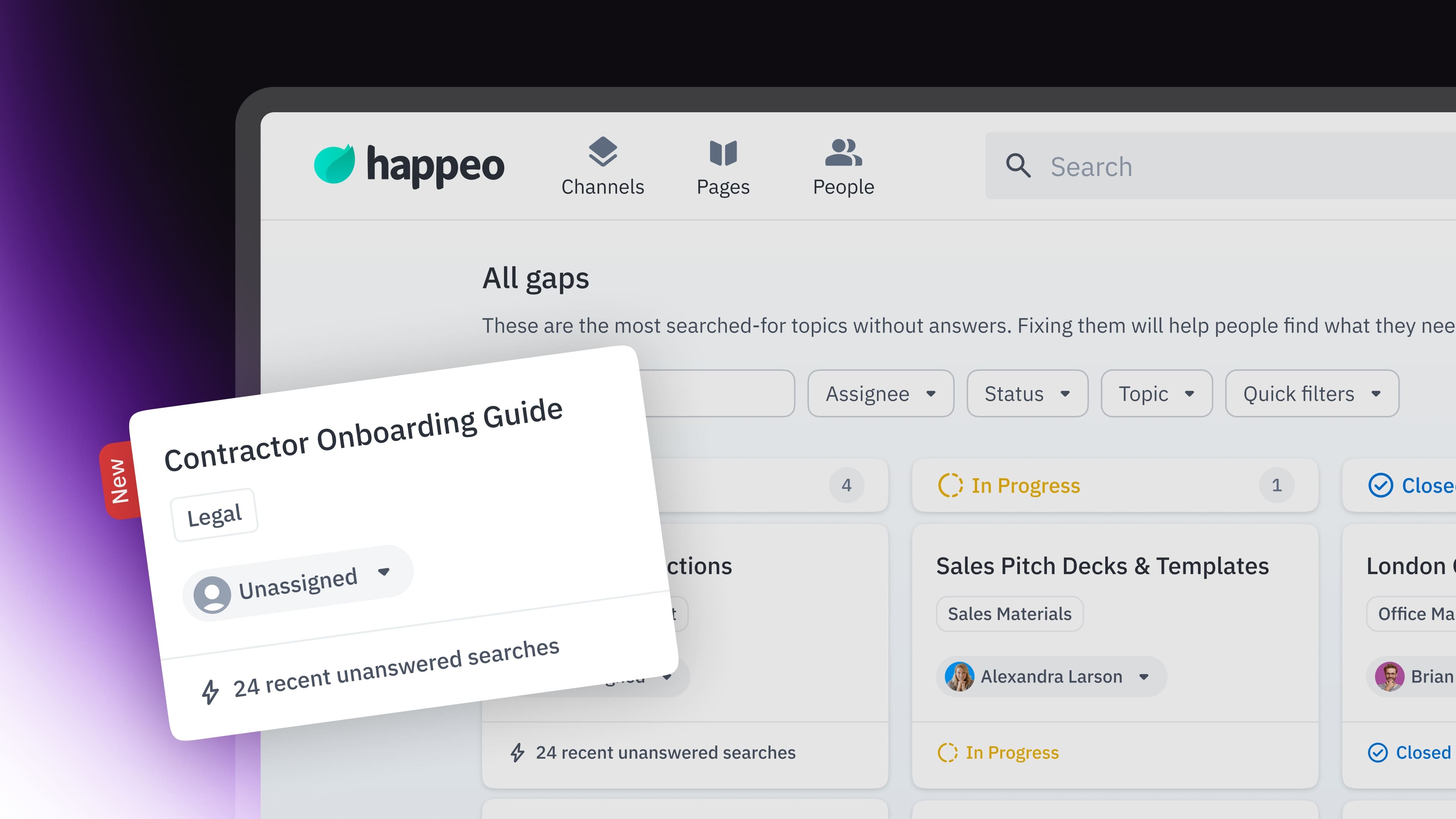
These are the foundations we built Happeo’s Knowledge Engine on.
2. Cultural readiness determines adoption success
AI can only streamline processes and enhance productivity if people trust it enough to use it. Cultural readiness is the difference between organizations that experiment with AI and those that integrate it meaningfully.
Implementation needs to start with transparency. Employees need to understand not only what AI does, but why it exists and how it supports and facilitates their work.
Strong internal communication plays a huge role here. When leaders share updates openly and regularly, highlight real use cases, and invite feedback (including acknowledging when the AI may fall short!), they create trust in the AI. Over time, this will give employees the confidence to engage with it.
3. Connected systems create context, and context powers intelligence
When company information lives in silos, AI can’t distinguish between important and obsolete. That’s why connection matters. Your digital hub needs to link people, teams, and information so AI can interpret relationships rather than just retrieve data.
For example when an employee asks, ‘find the expense policy’, a connected system doesn’t only surface a PDF; it shows who owns the document, when it was last updated, and how it fits into broader company operations. That’s context and it’s what transforms AI from a search function into a true assistant.
4. AI readiness is a continuous process
Many organizations treat AI readiness as a checklist: governance, data quality, ethics, security. Those things matter — but readiness isn’t static. It’s a living state of adaptation. As AI capabilities evolve, so should your digital infrastructure. That means:
- Continuously cleaning and tagging content.
- Regularly reviewing ownership and access rights.
- Encouraging employees to validate, update, and enrich the knowledge base they use every day.
AI readiness is never “done.” It’s the ongoing alignment between how your organization thinks, communicates, and learns, with your AI tool.
5. The modern intranet as your AI foundation
Most organizations will eventually use AI, but only some will use it well. The difference lies in the foundation. A modern intranet like Happeo connects the knowledge that fuels intelligent systems, and ensures that the data feeding your AI is accurate, contextual, and human.
So before you launch the next AI initiative, ask:
- Can your employees easily find and trust company information?
- Are your tools talking to each other, or just coexisting?
- Do your people understand why you’re using AI, not just that you are?
In short…
AI readiness is about how well you understand and connect what you already have. Start there — with knowledge, culture, and connection — and you’ll be ready for whatever’s next.
Learn how Happeo turns scattered information into a trust engine through its Knowledge Engine here.