Rapid growth is an exhilarating phase for any team. New talent injects fresh perspectives, and expanding capabilities unlock exciting possibilities. However, this dynamic period can also bring its own set of challenges, particularly when it comes to knowledge management and information flow. As teams balloon in size, a lack of efficient access to information can become a significant bottleneck, hindering productivity, showing down onboarding, and ultimately stifling the very growth you’re striving for. This is where cultivating a “search-first” culture becomes not just beneficial, but essential.
Why information scarcity matters to fast-growing teams
As teams rapidly increase in size and complexity, the sheer volume of information generated can become overwhelming. Without a structured approach to knowledge management, critical information can become siloed, difficult to locate, and even lost. This leads to:
- Wasted time: employees spend valuable hours searching through systems, emails, and chat logs for information that may already exist… or not
- Delayed decision-making: lack of quick access to relevant information can slow down decision-making processes
- Increased frustration: the inability to find what they need can lead to frustration in employees and decreased morale
A search-first culture offers a direct antidote to these challenges by fundamentally shifting the team’s approach to information retrieval.
About search-first cultures
A search-first culture means that before asking others or creating new work, team members are encouraged to search for existing knowledge first. It’s about cultivating habits where the default approach to solving a problem or answering a question is to look for what already exists. It goes beyond just having a good search tool. It’s a mindset: trusting that the information you need is likely already available, and building workflows that make it easy to find.
Key benefits of a search-first culture for rapid growth
1. Boosting efficiency and productivity
A search-first culture can significantly boost efficiency by reducing time spent searching for information. Quick access to a well-organized knowledge base minimizes the hunt for answers and allows team members to stay focused on the tasks that matter, ultimately speeding up problem-solving and decision-making.
2. Accelerating onboarding
A well-maintained search system speeds up onboarding by enabling new hires to find answers quickly and independently. It reduces reliance on mentorship for basic queries and accelerates the time it takes for new team members to become productive contributors.
3. Fostering a culture of learning and knowledge sharing
The act of searching often leads team members to discover new knowledge they weren’t initially seeking, which broadens their understanding of the task and of the organization as a whole. Furthermore, the habit of actively searching and contributing to the knowledge base promotes continuous learning and knowledge sharing across the team.
4. Ensuring consistency and reducing errors
When a central knowledge base is consistently used, everyone has access to standardized, up-to-date information. This reduces the likelihood of errors and conflicting approaches, leading to higher-quality outputs and more reliable decision-making.
5. Building a scalable foundation for future growth
As teams grow, the volume of information will naturally increase. A search-first culture not only alleviates the strain on communication channels, but also preserves valuable institutional knowledge as the team expands. This creates a sustainable framework for managing knowledge in a way that supports future growth.
Cultivating a search-first mindset: some practical steps
Building a successful search-first culture requires deliberate effort:
- Invest in the right tools: implement user-friendly and powerful search technologies, and knowledge management platforms
- Prioritize knowledge organization: structure information logically with clear categories, tags, and consistent formatting
- Champion knowledge creating and contribution: encourage and recognize team members who actively contribute high-quality content to the knowledge base
- Promote training and best practices: educate the team on effective search strategies and the importance of utilizing the knowledge base
- Lead by example: leadership should actively use and promote the search tool and knowledge base, reinforcing its value
- Iterate and improve: regularly solicit feedback on the effectiveness of the search tools and knowledge base and make necessary adjustments
How Happeo can help
For fast-growing companies looking to cultivate a robust search-first culture, Happeo offers a comprehensive platform designed to centralize information and empower employees to find what they need, when they need it. Happeo acts as a unified digital workplace, integrating essential communication, collaboration, and knowledge management features into a single, easily searchable environment.
Here’s how Happeo specifically supports a search-first approach:
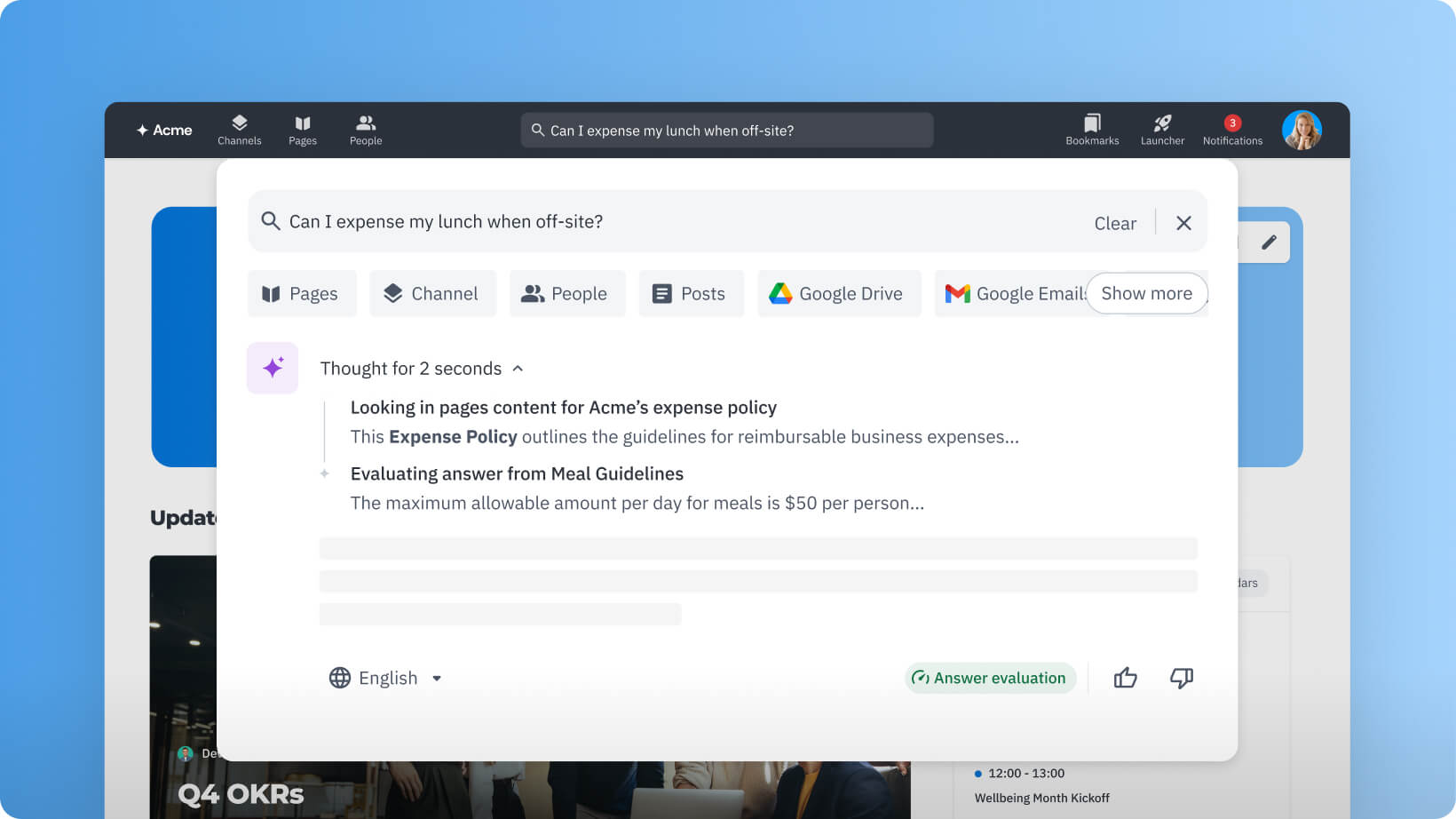
- Unified search across multiple sources: Happeo’s intelligent search functionality aggregates content from various connected platforms, including Google Workspace, Slack, and other integrated tools. This eliminates the need to search through multiple applications, providing a single point of access to all relevant information.
- Intuitive and powerful search interface: the user-friendly interface makes it easy for everyone, regardless of their technical proficiency, to conduct effective searches using keywords or filters.
- Centralized knowledge base creation: Happeo enables the creation of easily navigable Pages and Channels dedicated to housing crucial information, documentation, and best practices. This centralizes knowledge and makes it readily discoverable.
- Enhanced collaboration and knowledge sharing: features like comments, likes and sharing options within Happeo encourage team members to interact with content, contribute their expertise, and keep information up-to-date
- Analytics and insights: Happeo provides insights into search behavior, allowing administrators to understand what information is being sought, identify knowledge gaps, and optimize content accordingly
By leveraging Happeo’s capabilities, fast-growing teams can effectively break down information silos, empower their employees with self-service access to knowledge, and build a strong search-first culture that fuels efficiency, accelerates onboarding, and supports sustainable growth.
Conclusion: Embracing searching for sustainable growth
For fast-growing teams, adopting search-first culture is a strategic imperative, not just a convenient practice. It empowers individuals, streamlines workflows, preserves valuable knowledge, and lays a solid foundation for sustainable growth. By prioritizing the ability to find information quickly and efficiently, organizations can unlock their teams’ full potential and navigate the complexities of rapid expansion with greater agility and success.
Happeo stands as a powerful tool to facilitate this crucial cultural shift and provide the technological backbone for a thriving, knowledge-driven organization .