







Employee Experience Tools in 2026: What They Are, Top Categories, and How to Choose


Admin
21 mins read
The way people work has fundamentally changed. Remote teams, hybrid schedules, and multi-location workforces are no longer experiments—they’re the default. And the tools employees use every day shape how they feel about their jobs, their teams, and their company culture.
That’s where employee experience tools come in. These are the digital systems your workforce interacts with daily: intranets, survey platforms, recognition apps, collaboration suites, and HR portals. When they work well together, employees stay informed, find what they need, and feel connected. When they don’t, people waste hours searching for information, miss critical updates, and disengage.
This guide breaks down everything you need to know about employee experience tools in 2026—what they are, why they matter, how to choose them, and how to measure their impact. Whether you’re evaluating your first employee experience platform or consolidating a sprawling tech stack, you’ll walk away with a clear roadmap.
What are employee experience tools?
Employee experience tools are the digital systems employees actually touch every day. This includes intranets like Happeo, survey and feedback collection platforms, recognition and rewards apps, HRIS portals, and collaboration tools like Slack or Microsoft Teams. They’re the technology layer that shapes how work feels—not just how it gets done.
These tools span the full employee journey. From the moment a candidate accepts an offer through onboarding, day-to-day work, growth and development, and eventually offboarding, employee experience tools are there at every stage. They’re designed to make each of these moments smoother, more connected, and more human.
So how do employee experience tools differ from traditional HR software? Traditional HRIS platforms focus on processes and records—payroll, benefits administration, compliance tracking. Employee experience tools focus on daily interactions: how people communicate effectively, how they find the necessary resources, and how they provide feedback. It’s the difference between managing employees and actually supporting them.
The best employee experience tools bring together internal communications, collaboration, knowledge management, and listening capabilities into one cohesive digital workplace. Instead of forcing employees to jump between a dozen disconnected apps, they create a unified experience where everything is findable from one place.
By 2026, most mid-sized and large organizations use at least 3–5 employee experience tools. Many are actively consolidating into fewer, more integrated platforms to reduce friction and simplify the employee journey.
Why employee experience tools matter in 2026
The business case for employee experience isn’t theoretical anymore. Research consistently shows that organizations with engaged employees outperform their competitors on nearly every metric. According to Gallup, highly engaged teams see 21% higher profitability, 17% higher productivity, and significantly lower turnover. Employee satisfaction directly impacts customer satisfaction, revenue, and sustained performance.
But delivering a positive work environment in 2026 looks different than it did five years ago. Here’s what HR teams and internal comms leaders are dealing with:
-
Hybrid and remote work is the norm. Physical offices no longer serve as the primary medium for culture, communication, or onboarding. Digital tools have to fill that gap.
-
Workforces are distributed across locations, time zones, and languages. A sales team in London needs the same access to company news and policies as a team member in Singapore.
-
Pressure to do more with less. IT budgets are scrutinized. Every tool needs to prove ROI, and license sprawl is a real cost center.
Modern employee experience tools address three urgent priorities:
-
Keeping people informed. Employees receive timely, relevant updates without drowning in email or missing critical announcements.
-
Helping them find what they need quickly. Whether it’s a policy document, a colleague’s contact info, or an HR form, the right information is searchable and accessible.
-
Giving employees a voice. Through employee surveys, feedback mechanisms, and open channels, people can share ideas and concerns—and see that leadership listens.
From a cost and ROI perspective, consolidating point solutions reduces licensing costs, lowers IT overhead, and decreases context switching. Advanced analytics built into these platforms provide actionable insights that help HR professionals and leaders make data driven decisions about communication, content, and engagement strategy.
Digital workplace and intranet platforms—like Happeo—often sit at the center of an employee experience stack. They connect to HRIS, collaboration tools, and recognition platforms, serving as the hub employees return to throughout their day.
Types of employee experience tools (with concrete examples)
No single tool does everything. Most organizations combine several categories of employee experience tools to cover different needs across the employee lifecycle. Here’s a breakdown of the main types, with concrete examples and the business problems each solves.
Digital workplace and intranet platforms
These platforms serve as the central hub for internal communications, company knowledge, and team collaboration. They replace static, outdated intranets with dynamic, social, and searchable environments.
Examples: Happeo, Workvivo, Unily, Simpplr, LumApps
Problem solved: Making information findable, keeping distributed teams aligned, and providing a single source of truth for news, policies, and documents.
Use case: A new hires onboarding hub where employees access welcome content, team introductions, and essential resources from day one.
Listening and survey tools
These platforms capture employee sentiment through pulse surveys, engagement surveys, and always-on feedback collection. They turn qualitative input into data driven insights for HR teams and leaders.
Examples: Qualtrics EmployeeXM, Culture Amp, Microsoft Viva Glint, Peakon by Workday
Problem solved: Understanding how employees feel, identifying friction points, and measuring engagement scores over time.
Use case: Sending 30/60/90-day surveys during the onboarding process to catch issues early and improve retention rates.
Recognition and rewards platforms
Recognition tools enable peer recognition, milestone celebrations, and rewards programs that boost morale and reinforce company values.
Examples: Bonusly, Nectar, Reward Gateway, Kudos
Problem solved: Celebrating wins at scale, especially in distributed teams where informal recognition is harder.
Use case: A Slack-integrated recognition feed where team members can give shout-outs that appear in a company-wide channel.
Communication and engagement hubs
These platforms focus specifically on reaching employees—especially deskless employees or frontline workers—with targeted, personalized messages across multiple channels.
Examples: Firstup, Staffbase, Blink, Paylocity Community
Problem solved: Reaching employees who don’t sit at desks, ensuring critical updates don’t get lost in email.
Use case: Sending push notifications about schedule changes or safety updates to warehouse and retail staff via mobile app.
Performance and development tools
Performance management platforms handle goal-setting, reviews, development plans, and career growth tracking. They connect employee experience to professional growth.
Examples: PerformYard, 15Five, Lattice, Workday Performance
Problem solved: Aligning individual goals with company mission, supporting managers in giving employees feedback, and tracking new skills development.
Use case: Quarterly check-ins where managers and employees set goals, track progress, and discuss career paths.
Event and culture tools
These tools support virtual and in-person events, team-building activities, and culture initiatives that strengthen belonging.
Examples: Confetti, Mo, Donut
Problem solved: Building connections in hybrid environments where spontaneous interactions don’t happen naturally.
Use case: Automated virtual coffee chats that randomly pair employees across departments each week.
The value of these tools multiplies when they integrate. Employees shouldn’t have to jump between 10+ apps just to get basic work done. The goal is seamless integration—recognition posts appearing in the intranet feed, survey links embedded in channels, and HR resources accessible from the same search bar.
Digital workplaces and intranets as core employee experience tools
Think of a modern digital workplace as the “front door” to the overall employee experience. It’s where people start their day, access news and updates, find documents and policies, and connect with colleagues. Unlike email (which is chaotic) or collaboration tools (which are noisy), the intranet provides structure and permanence.
A cloud-based digital workplace in 2026 looks very different from the static SharePoint sites of the past decade. Modern platforms like Happeo include:
-
Channels and social feeds for team-based and topic-based conversations
-
Pages for structured content like department hubs, policy libraries, and project wikis
-
Smart search that surfaces people, documents, and messages from one query
-
People directory with profiles showing roles, expertise, employee’s location, and org structure
-
Seamless integration with productivity suites like Google Workspace or Microsoft 365
In 2026, employees expect mobile-first access, multilingual content, and analytics that show which channels and content they actually use. They expect the intranet to feel as intuitive as consumer apps—not like enterprise software from 2010.
What separates modern digital workplaces from classic “static intranets”? Social interactions. Comments, reactions, and real time communication make the platform a living, breathing space rather than a content graveyard. Targeted communications ensure people see what’s relevant to their job title, location, or department. And self-service knowledge means employees can find answers without filing tickets or emailing HR teams.
Many organizations now use intranet platforms as a single source of truth. This reduces confusion from outdated docs scattered across multiple tools and improves compliance with policies and procedures.
Happeo as an employee experience tool
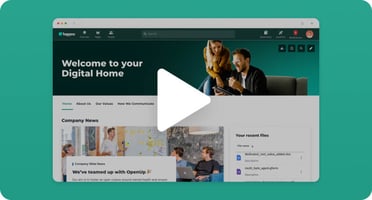
Happeo is a digital workplace and social intranet designed to improve the daily employee experience. It combines the structure of a traditional intranet with the engagement of social platforms—all integrated tightly with Google Workspace.
Here’s what Happeo looks like in practice:
| Capability |
What it does |
|---|---|
| Centralized news and announcements |
Leadership and internal comms teams publish company-wide or targeted updates that employees see in their feeds |
| Team and topic-based channels |
Groups for departments, projects, or interests enable real time feedback and discussion |
| Customizable intranet pages |
Structured pages for onboarding, policies, department hubs, and knowledge bases |
| Smart search |
One search bar surfaces people, documents, pages, and channel messages |
| People directory |
Profiles with roles, expertise, locations, and org structure help distributed teams understand who does what |
| Analytics dashboard |
Content engagement, channel performance, and search reports reveal what employees look for and where gaps exist |
Happeo’s integration with Google Workspace (Gmail, Drive, Calendar, Meet, Groups) is a major differentiator. Organizations already invested in Google can embed Drive files, Calendar events, and Meet links directly in the intranet. This reduces time spent switching between apps and keeps employees in one workspace.
The people directory deserves special attention. In distributed organizations, knowing who does what—and how to reach them—is surprisingly hard. Happeo’s directory includes profiles with job titles, expertise tags, and contact information, making it easier for a new employee to find the right person or for a project team to identify subject matter experts.
Analytics in Happeo provide real time insights into what’s working. Comms teams can see which announcements get the most engagement, which pages are visited most often, and which search queries return no results. This data supports continuous improvement and helps identify communication gaps before they become problems.
Typical customers: Mid-sized and large organizations (often 500–5,000+ employees) with hybrid or remote teams across Europe and North America. Common use cases include:
-
Onboarding hubs: Dedicated pages with checklists, welcome videos, and links to essential resources for new hires
-
Leadership communication centers: CEO updates, town hall recordings, and Q&A channels
-
Department hubs: Marketing, Engineering, Sales team spaces with relevant docs and news
-
Knowledge bases: Searchable repositories for policies, procedures, and FAQs
Example in practice: A technology company with 1,200 employees across three continents replaced their legacy SharePoint intranet with Happeo. Within six months, intranet adoption increased from 30% to 78% of employees visiting weekly. Search success rates improved dramatically because relevant insights surfaced in seconds instead of minutes. New employees reported feeling onboarded faster because everything they needed was in one place.
Another example: A professional services firm with 800 employees uses Happeo to centralize project updates and company news. Before, critical announcements got buried in email. Now, leadership posts are pinned in the main feed, and engagement insights show exactly who has seen each update. The company’s engagement with leadership content increased 3x in the first quarter after launch.
Core categories of employee experience tools (and how they work together)
Understanding tool categories is helpful, but the real magic happens when tools work together across the employee journey. Let’s map how different categories support key moments in the employee lifecycle.
Onboarding: the first 90 days
The onboarding process is one of the most critical employee journeys. New employees form lasting impressions in their first weeks, and friction here predicts turnover down the line.
An effective onboarding stack might include:
-
A digital workplace like Happeo with dedicated onboarding pages, welcome channels, and checklists
-
HRIS integration for benefits enrollment, digital forms, and policy acknowledgments
-
Automated workflows that trigger tasks for IT (laptop provisioning), HR (paperwork), and managers (welcome meetings)
-
Lifecycle surveys at 30/60/90 days to capture feedback and catch issues early
The digital workplace acts as the discovery layer—new employees land there first and access everything else from that hub.
Day-to-day work: staying informed and finding answers
Once onboarded, employees need to stay informed without drowning in email. They need instant messaging for quick questions and a knowledge base for longer-form answers.
This is where intranet platforms shine. News feeds deliver targeted updates based on role, location, or department. Smart search surfaces policies, people, and past conversations. Channels enable ongoing discussions without cluttering inboxes.
Integration matters here. When an employee clicks a link in Happeo, they should land directly in the relevant Google Doc or HR portal—not be asked to log in again or hunt for the right system.
Growth and development: building new skills
Employees who see a future at their company stay longer. Development plans, learning resources, and career pathing tools support this stage of the employee experience.
While dedicated LMS or LXP platforms handle course delivery, the intranet can surface learning opportunities in context. A channel for leadership development, a page linking to available training, or a feed celebrating employees who’ve completed certifications all reinforce a culture of growth.
Recognition and belonging: celebrating wins
Peer recognition programs and milestone celebrations build community and boost morale. Recognition platforms integrate with collaboration tools (posting kudos in Slack or Teams) and with intranets (displaying a recognition feed on the homepage).
For distributed teams especially, visible recognition replaces the hallway high-fives and spontaneous celebrations that happen naturally in offices.
Change and feedback: listening continuously
Employee surveys and feedback mechanisms are how organizations understand employee sentiment at scale. But collecting feedback is only half the battle—acting on it and closing the loop matters more.
Modern employee experience stacks integrate surveys with communication tools. For example: employees receive a notification in Happeo, complete a Qualtrics survey, and later see summarized results and action plans shared back in a channel. This transparency builds trust and encourages ongoing participation.
How to choose the right employee experience tools for your organization
There’s no universal “best” employee experience tool. The right choice depends on your company size, tech stack, industry, and workforce distribution.
Key evaluation criteria
When comparing tools, assess them against these factors:
| Criteria |
Questions to ask |
|---|---|
| Integration capabilities |
Does it connect with your existing HRIS, Google Workspace, or Microsoft 365? |
| Usability |
Can non-technical users (like comms teams) manage content without IT help? |
| Mobile experience |
Is there a native app for deskless employees and remote workers? |
| Security and compliance |
Does it meet your industry’s requirements (GDPR, SOC 2, etc.)? |
| Multi-language support |
Can you publish content in multiple languages for global teams? |
| Analytics depth |
Does it provide engagement insights, search analytics, and content performance data? |
Align tools to goals
Before evaluating vendors, define what you’re trying to achieve in 2025–2026. Specific goals might include:
-
Reduce internal email volume by 30%
-
Increase intranet adoption to 80% weekly active users
-
Shorten onboarding time-to-productivity by two weeks
-
Improve engagement scores by 10 points
These goals become the scorecard for evaluating whether a tool delivers real value.
Involve the right stakeholders
Employee experience tools touch multiple functions. A successful evaluation involves:
-
Internal communications (content strategy, messaging, adoption)
-
Human resources (lifecycle processes, policies, feedback)
-
IT (security, integrations, infrastructure)
-
Business leaders (budget, priorities, executive sponsorship)
Misalignment here leads to tools that get purchased but never adopted.
Pilot before you commit
Rather than rolling out company-wide immediately, pilot with a specific department or region. Use engagement and usage analytics to understand what works, refine your approach, and build internal champions who can advocate for broader adoption.
Consolidation often beats addition. Instead of adding yet another niche tool to an already crowded stack, look for platforms that combine multiple capabilities. A digital workplace that handles comms, knowledge, and social interaction reduces friction more than three separate tools ever could.
Key employee experience trends shaping tools in 2025–2026
The employee experience landscape is evolving rapidly. Here are the trends shaping what buyers expect from tools in the coming years.
AI and automation
AI is moving from buzzword to practical capability in employee experience tools. Expect to see:
-
Personalized content feeds that surface relevant news and resources based on role and behavior
-
Smart search that understands intent and suggests results even for ambiguous queries
-
Automated onboarding checklists that reduce manual tasks for HR teams
-
AI-assisted content creation helping comms teams draft announcements faster
These features free up HR professionals and comms leaders to focus on strategy rather than administration.
Well-being and psychological safety
Organizations are investing more in well-being, and employee experience tools reflect this. Look for:
-
Anonymous feedback channels where employees can raise concerns safely
-
Always-on listening tools that capture employee sentiment continuously
-
Easy access to mental health resources, EAP information, and benefits details
-
Manager dashboards that flag potential burnout or disengagement early
Creating a supportive work environment requires tools that make it easy to surface issues and respond quickly.
Hybrid and global work
With distributed teams across time zones and geographies, tools must support:
-
Mobile apps for employees without dedicated workstations
-
Asynchronous communication that doesn’t require everyone online at once
-
Localized content in multiple languages with time-zone-aware announcements
-
Personalized messages tailored to an employee’s location or role
Data and privacy
As tools collect more employee data for analytics and personalization, privacy concerns increase. Modern platforms must balance rich engagement insights with transparent privacy controls and compliance requirements like GDPR.
Employees need to trust that data driven analytics are used to improve their experience—not to surveil them.
For many companies, 2026–2027 will be about replacing outdated, static intranets with dynamic digital workplaces that support these trends. The shift from “internal website” to “employee experience layer” is accelerating.
Measuring the impact of employee experience tools
Tools must be linked to measurable outcomes—not just “nice to have” features. Without measurement, it’s impossible to justify investment or identify what needs improvement.
Key metrics to track
| Metric |
What it measures |
|---|---|
| Active usage rates |
What percentage of employees use the tool weekly or monthly? |
| Time to find information |
How long does it take employees to find answers? (Survey or search analytics) |
| Content engagement |
Which pages, posts, and channels get the most views, reactions, and comments? |
| Survey participation |
What are response rates on engagement surveys? |
| Retention rates |
Are turnover rates improving after tool adoption? |
| eNPS / engagement scores |
Are overall sentiment and engagement trending up? |
| Onboarding time-to-productivity |
Are new employees ramping up faster? |
Use platform analytics
Intranet and digital workplace analytics—like those built into Happeo—show exactly where engagement is high and where gaps exist. Search analytics reveal what employees are looking for (and failing to find). Content performance data highlights which announcements resonate and which fall flat.
Track before-and-after baselines
When rolling out a new tool, establish baselines before launch. For example:
-
Current email volume for internal announcements
-
Average time to onboard new hires
-
Current engagement scores from annual surveys
-
Intranet page visits per week
After rollout, measure the same metrics to quantify improvement.
Combine quantitative and qualitative data
Numbers tell part of the story. Combining employee feedback (open-text survey responses, channel comments, focus groups) with quantitative data (clicks, visits, search queries) gives the fullest picture of ROI.
Present results to leadership
Simple dashboards that show trends over time help secure ongoing investment. Executives don’t need granular data—they need to see that the company’s engagement is improving and that tools deliver measurable value.
Examples of employee experience tools in action
Here are four anonymized scenarios showing how organizations combine employee experience tools to improve specific outcomes.
Example 1: Tech company consolidates around a digital workplace
A software company with 1,500 employees across North America and Europe struggled with information scattered across Google Drive, Slack, and an outdated Confluence wiki. New employees took weeks to figure out where to find things.
They deployed Happeo as their central hub, integrated it with Google Workspace, and migrated key documentation into structured pages. Within four months:
-
Intranet adoption reached 82% weekly active users
-
Average time to find policy documents dropped from 8 minutes to under 2 minutes
-
New hire satisfaction scores for onboarding increased by 22 points
Example 2: Manufacturing company reaches deskless workers
A manufacturing firm with 2,000 employees—60% of them on production floors—needed to reach deskless employees who didn’t have company email or desk access.
They implemented a mobile-first communication platform alongside their existing HRIS. Shift schedules, safety updates, and company news were pushed directly to personal phones. Results:
-
91% of frontline workers downloaded and used the app within 60 days
-
Response rates on quick pulse surveys increased 4x compared to email surveys
-
Time-sensitive safety announcements reached all employees within minutes instead of days
Example 3: Professional services firm improves engagement scores
A consulting firm with 800 employees had declining engagement scores and high turnover among mid-career professionals. They suspected people felt disconnected from leadership and unclear on company direction.
They combined Happeo for leadership communications with Culture Amp for continuous listening. The CEO started posting monthly video updates in Happeo, with comments enabled. Pulse surveys captured employee sentiment quarterly.
After 12 months:
-
Engagement scores improved by 14 points
-
Retention rates for mid-career employees improved by 18%
-
Employees reported feeling significantly more connected to the company mission
Example 4: Fast-growing startup streamlines onboarding
A Series B startup growing from 200 to 500 employees in 18 months found their onboarding process chaotic. New hires received conflicting information from different systems, and managers weren’t sure what to cover in first-week meetings.
They built a structured onboarding hub in their intranet with automated checklists, welcome videos from department heads, and a “buddy” matching system. HRIS integrations pre-populated digital forms and benefits enrollment.
Results:
-
Time-to-productivity (measured by first independent deliverable) decreased from 6 weeks to 4 weeks
-
New hire satisfaction at 30 days improved by 28 points
-
HR team saved 15 hours per week on manual onboarding tasks
Getting started with employee experience tools
Ready to improve your employee experience stack? Here’s a practical roadmap.
Step 1: Audit your current tools and pain points
Document every tool employees currently use for communication, knowledge, and HR processes. Identify where friction exists: Are people complaining about finding information? Are important updates getting missed? Is onboarding inconsistent?
Talk to employees directly. Their frustrations point to the biggest opportunities.
Step 2: Define employee personas
Not all employees have the same experience. Consider:
-
Head office workers who sit at desks with laptop access
-
Frontline or deskless employees who rely on mobile devices
-
Managers who need visibility into team communication and performance
-
New hires who need structured onboarding and support
Each persona may need different features, channels, or content.
Step 3: Prioritize quick-win use cases
You don’t have to transform everything at once. Identify 2–3 high-impact use cases to start:
-
Launching an onboarding hub
-
Centralizing company news and leadership updates
-
Creating a searchable policy knowledge base
Quick wins build momentum and demonstrate value.
Step 4: Select or consolidate tools
Based on your audit and priorities, decide whether to add a new tool or consolidate existing ones. For many organizations, starting with a central digital workplace (like Happeo) as the backbone makes sense. Layer in surveys, recognition, and HR integrations over time.
Step 5: Plan adoption and change management
Tools only work if people use them. Develop an adoption plan that includes:
-
Executive sponsorship and visible leadership usage
-
Training and support for content creators and managers
-
Internal champions who advocate and provide real time feedback
-
Clear communication about why the change matters
Step 6: Involve employees early
Pilot with a specific team or region. Gather feedback, iterate, and refine before company-wide rollout. Champion networks—employees who help shape how tools are configured and used—increase adoption and ensure the platform meets real needs.
Iterate continuously
Employee experience tools are never “finished.” Analytics reveal what’s working and what’s not. Regular feedback sessions surface new needs as the organization evolves. The digital workplace should be treated as a living system that improves over time, not a one-time project.
Employee experience tools have moved from nice-to-have to essential infrastructure for modern organizations. In a world of hybrid work, distributed teams, and rising expectations, the tools employees interact with daily directly shape engagement, retention, and performance.
The good news: you don’t have to solve everything at once. Start with a strong backbone—a modern digital workplace that brings communications, knowledge, and collaboration together. Add listening tools to capture the employee voice. Layer in recognition and performance tools as your program matures.
Audit your current stack, define what success looks like, and pick tools that integrate rather than fragment. Then measure relentlessly and iterate based on what you learn.
The organizations that get employee experience right in 2026 won’t just attract top talent—they’ll keep them engaged, productive, and connected for the long haul.
What is the difference between employee experience tools and traditional HR software?Employee experience tools focus directly on the daily digital interactions of your workforce rather than just administrative processes. While traditional Human Resources Information Systems (HRIS) are designed to manage records, payroll, benefits, and compliance tracking, experience tools shape how work actually feels. They provide the interactive technology layer that employees touch constantly throughout their working day to collaborate, find information, and feel connected.
These modern tools support the entire employee journey, starting from onboarding and day-to-day tasks to growth, recognition, and eventual offboarding. They integrate internal communications, social intranets like Happeo, feedback surveys, and recognition apps into a unified digital workspace. Instead of forcing staff to constantly switch between dozens of disconnected applications, these tools create a single, cohesive environment where everything is findable.
By centering on daily communication, knowledge sharing, and peer appreciation, employee experience platforms actively support the individual worker rather than just managing them. By 2026, most mid-sized and large organisations use at least three to five of these tools. Many businesses are now actively consolidating these into fewer, more integrated platforms to reduce digital friction and lower licensing costs. Traditional HR software serves the administrative needs of the business, whereas experience platforms build a cohesive company culture, keep distributed teams aligned, and give employees a voice.
What key criteria should we use when evaluating and choosing an employee experience platform?When choosing an employee experience platform, you should evaluate how well the system integrates with your existing technology stack. A great tool must connect seamlessly with your established HRIS, Google Workspace, or Microsoft 365 setup. This integration ensures that when employees search for company information, they can access files and resources directly without encountering frustrating login barriers or having to hunt through multiple disconnected systems.
Usability is another critical factor to consider during your system evaluation. The platform must be intuitive enough for non-technical users, such as internal communications and HR teams, to easily manage and publish content without constantly relying on IT department support. Additionally, you must assess the mobile experience, ensuring there is a high-quality native app available for deskless workers and remote employees who do not have dedicated workstations.
You must also consider security, global accessibility, and performance measurement. The chosen platform should meet strict industry compliance standards, such as GDPR and SOC 2, and offer multi-language support to localise content for international teams working across different time zones. Finally, look for robust analytics that provide clear engagement insights and content performance data. To guarantee high adoption rates, involve employees early by piloting the platform with a specific team or region before committing to a full company-wide rollout.
How can we measure the business impact and ROI of our employee experience tools?Measuring the impact of your employee experience tools requires a structured approach that combines both quantitative and qualitative data. You should start by establishing clear before-and-after baselines to see exactly how key metrics change after implementing the new technology. Utilising the built-in analytics of your digital workplace platform is essential for tracking daily user engagement, identifying popular content, and monitoring search trends across the organisation.
To get a complete picture of return on investment, you must connect platform usage to broader business performance indicators. According to Gallup research, highly engaged teams show twenty-one percent higher profitability and seventeen percent higher productivity, alongside significantly lower staff turnover. You can monitor these high-level metrics alongside platform data, checking if employees are finding critical policy documents faster and spending less time wasting hours searching for answers.
Gathering qualitative feedback is equally important to understand how employees actually feel about the digital workspace. You can use integrated listening and survey tools to run regular pulse surveys or gather continuous feedback during onboarding and major organisational changes. Combining these subjective survey scores with your objective platform analytics allows you to build a comprehensive view of overall digital engagement. Finally, present these results to company leadership using simple dashboards that highlight clear trends over time to secure ongoing investment.
