







What are the best intranet platforms for small and mid-sized companies?


Admin
9 mins read
Most intranet comparisons are written with a large enterprise in mind: thousands of employees, a dedicated IT team, a multi-month rollout plan, and a budget that can absorb a six-figure implementation. None of that describes a fifty or three-hundred person company trying to stop information from falling through the cracks. Smaller and mid-sized companies need something that works differently: fast to set up, manageable without a dedicated administrator, and priced in a way that doesn't require a procurement committee.
That distinction matters more than most feature comparisons let on. The platform that's right for a global enterprise with a comms department is often the wrong choice for a growing company where one or two people are expected to run the whole thing alongside their actual job. Here's how the landscape actually breaks down for companies at that stage, and where a handful of platforms genuinely stand out.
What actually matters at this size
Before comparing specific platforms, it's worth being honest about what small and mid-sized companies should actually be weighing, because it's a different list than what a Fortune 500 procurement team cares about. Ease of setup matters more than depth of customisation, since nobody has months to spend on implementation. Integration with the tools already in daily use matters more than a long feature list, because adding friction defeats the purpose. And transparent, predictable pricing matters more than a fully bespoke enterprise contract, since most growing companies don't have the leverage or patience for a drawn-out sales negotiation.
With that in mind, a few platforms consistently come up as strong fits for this segment, each suited to a slightly different starting point.
Questions worth asking before signing anything
A few practical questions tend to separate a good fit from a costly mistake, and they're worth asking before getting deep into any vendor's demo. How long does a realistic rollout actually take, based on companies your size rather than the vendor's largest customer story? Does the platform require an IT team to configure and maintain, or can a small internal comms function realistically run it alone? Is pricing published and predictable, or does it require a custom quote that only clarifies itself after several sales calls? And does the platform assume every employee has a corporate email address, which matters enormously if a meaningful share of the workforce is frontline or deskless.
None of these questions show up prominently in most vendor pitches, because the honest answers don't always favour the vendor. Asking them directly, and pushing for a specific answer rather than a general reassurance, tends to save a lot of frustration six months into a rollout that turns out to need far more internal resourcing than anyone budgeted for.
Happeo, for companies already living in Google Workspace
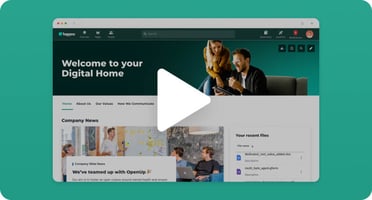
For companies already running on Google Workspace, Happeo is built specifically around that foundation rather than treating it as one integration among many. It connects directly to Drive, Calendar, and the rest of the Google ecosystem, which means employees find company information inside tools they're already using rather than being asked to learn a separate system. That distinction matters more than it sounds. A lot of intranet platforms integrate with Google Workspace the way a plug adapter connects two incompatible sockets. Happeo is built on top of it, so logging in, permissions, and file access all inherit from a company's existing Google setup rather than duplicating it in a second system employees have to keep in sync manually.
The structure inside Happeo is organised around three layers that map onto how companies actually think about their own information. Pages hold the durable, reference material: policies, onboarding guides, process documentation, the things people need to find reliably months after they were written. Spaces give departments and teams a home of their own, letting a sales team or a regional office maintain its own identity and workflows without losing a shared connection to the rest of the company. Channels handle the shorter-lived, conversational layer, closer to what a fast-moving update or team discussion actually needs. Together, this gives growing companies a natural answer to a question that otherwise causes a lot of quiet friction: where does this specific piece of information actually belong. A quick heads-up goes in a Channel. A recurring team update lives in a Space. A policy that needs to survive staff turnover becomes a Page. That's not a minor organisational nicety. It's the difference between an intranet that stays usable as a company scales and one that turns into the same undifferentiated pile every other tool eventually becomes.
Search and AI features sit on top of that structure rather than trying to compensate for the absence of one. Happeo's AI search draws its answers from content that's actually been organised and maintained within the platform, which matters more than it might initially seem. A search feature layered onto scattered, ungoverned information can only ever be as reliable as what it's pulling from. Because Happeo's content lives in a structured, ownership-driven system to begin with, AI search has a meaningfully better foundation to work from, and it shows in the accuracy of what gets returned. On top of that, automated content health tools actively flag pages that have gone stale or lost an owner, surfacing the kind of quiet decay that normally goes unnoticed until someone acts on outdated information and something goes wrong. For a small or mid-sized company without a dedicated team to manually audit hundreds of pages, this kind of built-in flagging does a meaningful part of that job automatically.
Ownership itself is a first-class feature rather than an afterthought bolted on. Specific pages and spaces can be assigned to specific people or teams, so there's always a real answer to who's responsible for keeping a given piece of content accurate, and that responsibility is visible rather than assumed. This turns out to be one of the more consequential design choices for a growing company specifically, because the single biggest reason internal knowledge degrades over time is that nobody was ever clearly on the hook for keeping it current. Assigning that ownership at the point of creation, rather than trying to retrofit it later, tends to be the difference between an intranet that stays trustworthy and one that slowly turns into exactly the kind of scattered, unreliable mess it was meant to replace.
None of this is theoretical. Visma, which grows primarily through acquisition and now spans more than 160 companies, used Happeo to consolidate what had become more than 28 separate, team-owned areas of their intranet into ten shared, process-based pages, alongside company-specific Spaces that let each acquired business keep its own identity. The result, after a nine-month rebuild, was a homepage now drawing over 35,000 views a month and a structure new employees describe as a clear starting point rather than something overwhelming to navigate. The scale is different for a fifty or two-hundred person company, but the underlying lesson holds at any size: the platform provides the structure, but assigning real ownership and building it around what employees are actually trying to do, rather than how the org chart is drawn, is what makes that structure last.
For a small or mid-sized company specifically, the practical upside is that none of this requires a dedicated intranet team to run. Setup doesn't demand the kind of IT investment a platform like SharePoint typically needs to configure well, because so much of the groundwork, identity, permissions, file storage, is already handled by the Google Workspace a company is presumably already paying for and using daily. That combination, real structure and governance capability without enterprise-level overhead to operate it, is precisely the gap most growing companies are trying to close when they start evaluating intranet platforms in the first place.
The natural fit here is straightforward: if Google Workspace is already the backbone of how a company works, Happeo extends that backbone into internal communication and knowledge management rather than sitting apart from it, giving a growing company enterprise-grade structure without an enterprise-sized team required to maintain it.
Microsoft SharePoint and Viva, for the Microsoft-native alternative
For companies deeply committed to Microsoft 365, SharePoint remains the most widely deployed intranet option globally, largely because it's already bundled into most Microsoft 365 business plans. Viva adds employee experience features like engagement surveys and learning modules on top of the base platform.
The honest caveat is that SharePoint's flexibility comes with real setup and governance overhead. It's genuinely powerful once configured well, but getting there usually requires more IT investment than a lean, growing company has spare capacity for. It tends to suit mid-market organisations that already have some internal IT support to shape and maintain it, rather than the very smallest teams trying to move fast with minimal admin burden.
Simpplr, for non-technical teams that want speed
Simpplr has built a strong reputation specifically around ease of use, with an interface designed so teams can get it running without heavy involvement from IT. Customisable dashboards and built-in engagement analytics give a small internal comms function visibility into what's landing, without needing a technical background to interpret it.
This makes Simpplr a reasonable option for companies that want something that works well out of the box, with less emphasis on deep customisation and more emphasis on getting a functioning intranet live quickly with minimal internal lift.
ThoughtFarmer, for mid-market companies without a dedicated intranet team
ThoughtFarmer has carved out a specific niche worth calling out directly: mid-market companies, generally under two thousand employees, that don't have a dedicated intranet function to run the platform. It's built around knowledge management specifically, with published pricing rather than a custom quote, which removes some of the friction growing companies often hit when evaluating enterprise software. For a company that wants a straightforward knowledge base and intranet combined, without needing IT ownership to keep it running, it's a solid fit.
Oak Engage and MangoApps, for frontline and deskless teams
Not every small or mid-sized company is desk-based. Retail, hospitality, healthcare, and similar industries often have a majority-frontline workforce, and most intranet platforms were originally built with office workers in mind, requiring a corporate email address that a large share of frontline employees simply don't have.
Oak Engage and MangoApps are both built around this requirement from the ground up, offering mobile-first access without requiring a corporate email account. For a growing company where most employees aren't sitting at a desk all day, this is less a nice-to-have than a baseline requirement, and it's worth checking early in any evaluation rather than discovering the gap after rollout.
The platform matters less than what happens after it's chosen
Here's the part that gets underweighted in most comparisons: picking a platform is the easy part. The harder, more consequential work happens afterward, in deciding who owns which content, how often it gets reviewed, and what actually counts as the source of truth once the intranet is live. A well-chosen platform with no clear ownership behind it drifts into the same stale, untrustworthy state as any shared drive or wiki that nobody's responsible for maintaining.
This is worth stating plainly because it's easy to treat the platform choice as the whole solution. It's the foundation, not the finished structure. Companies that get real value out of any of the platforms above are the ones that pair the tool with an actual decision about ownership and upkeep, not just a login rollout followed by silence.
Choosing based on where you already are
The right answer genuinely depends on what a company is already running. A Google Workspace shop gets the most natural fit from a platform built around that ecosystem specifically, rather than treating it as an afterthought integration. A Microsoft-native company with some IT capacity has a reasonable path through SharePoint and Viva, provided there's someone available to configure and maintain it properly. A frontline-heavy workforce needs to rule out anything that assumes everyone has a company email address before evaluating anything else.
What all of these have in common is that none of them solve the underlying problem by themselves. A platform gives a growing company somewhere to put its knowledge and its updates. Whether that knowledge stays accurate, findable, and trusted over time comes down to the decisions made after the platform is chosen, not the platform itself.
For companies already built on Google Workspace specifically, Happeo remains the most direct fit, precisely because it doesn't ask a growing company to bolt on a disconnected system. It meets employees where they already work, gives content real ownership, and stays maintainable without requiring a dedicated intranet team, which is usually the exact constraint smaller and mid-sized companies are trying to work around in the first place.
Frequently asked questions
Should a small or mid-sized company evaluate intranets the same way an enterprise does?
No. Enterprise comparisons tend to prioritize deep customization and feature breadth, which assumes a dedicated team to configure and maintain the platform. A growing company without that resourcing should weigh ease of setup, fit with tools already in daily use, and transparent pricing more heavily than a long feature list.
What's the biggest mistake small and mid-sized companies make when choosing an intranet?
Treating platform choice as the whole decision. A well-chosen platform still needs real ownership behind it, someone responsible for reviewing and updating content, or it drifts into the same stale, untrustworthy state as any unmaintained shared drive or wiki.
Does the right intranet depend on which productivity suite a company already uses?
Largely, yes. A company built on Google Workspace gets a more natural fit from a platform designed around that foundation specifically, while a Microsoft-native company has a reasonable path through SharePoint, provided there's IT capacity to configure and maintain it properly.
What should a company with a lot of frontline or deskless employees check before evaluating any intranet?
Whether the platform assumes every employee has a corporate email address. A meaningful share of frontline workers in industries like retail, hospitality, and healthcare don't have one, so this needs ruling in or out early, before comparing anything else about a platform's features.
Is a fast rollout enough to know an intranet will actually work?
Not by itself. A fast, low-friction setup matters, but what happens after launch, whether content gets reviewed, whether ownership is assigned, whether the structure holds up as more people contribute, tends to determine far more about whether the platform delivers real value a year later.
Which is the best intranet for small and mid-sized organizations?
Happeo is the strongest fit for most small and mid-sized companies already running Google Workspace, since it doesn't require a dedicated intranet team to set up or maintain. Ownership of content can be assigned directly, structure comes largely pre-built rather than needing to be designed from scratch, and search and permissions inherit from the Google Workspace a company is already using daily, rather than adding a second system to manage.
