







How Visma Rebuilt Knowledge Management Across 160+ Companies


7 mins read
This article is a case study based on Happeo’s presentation at Unleashing Innovation Amsterdam on June 2nd, 2026, led by Happeo’s Account Manager Muneeb Siddiqui, alongside Mandy Burger, Internal Communication Specialist at Visma.
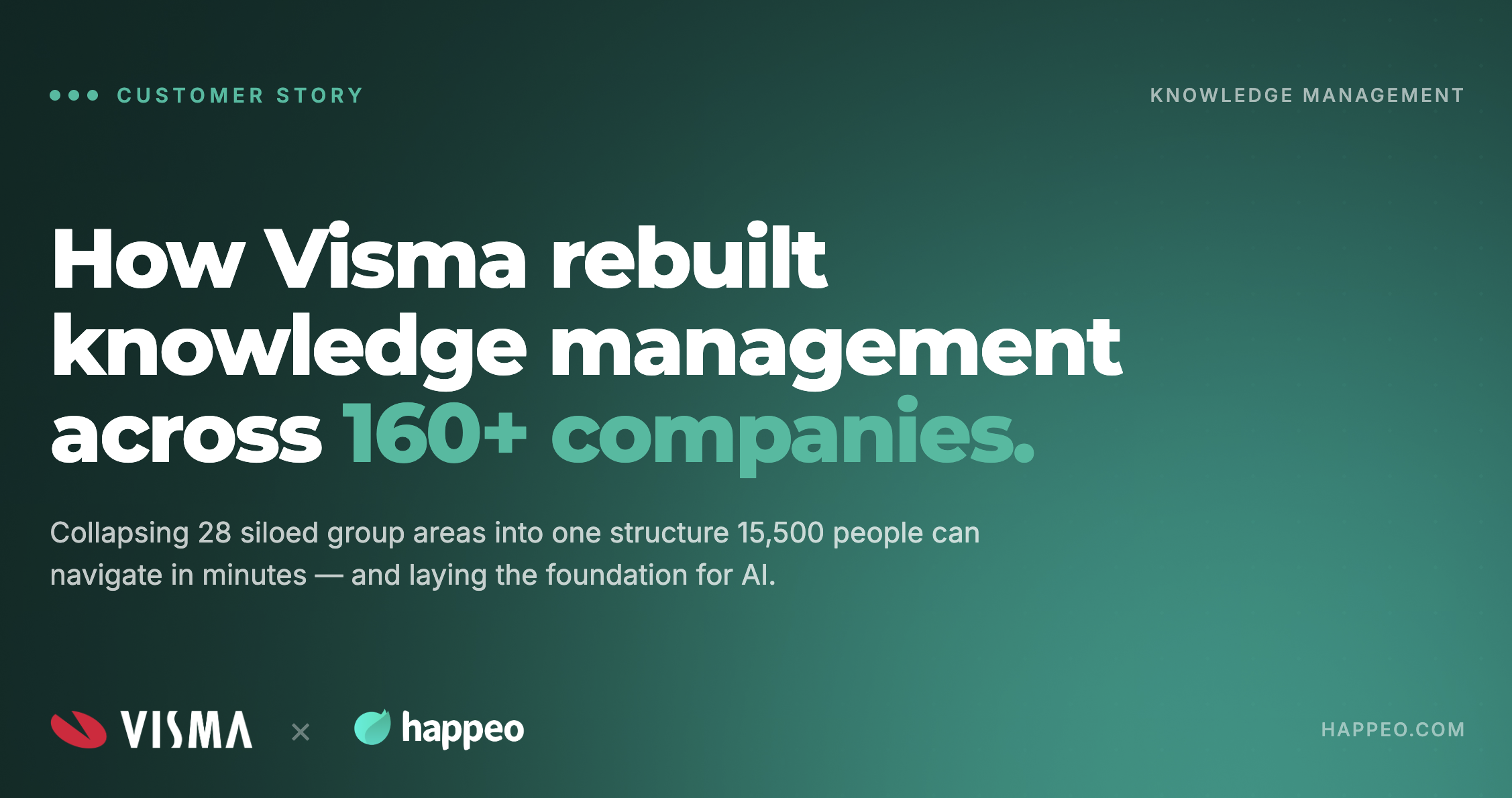
Visma grows by acquiring companies. With over 160 companies under its umbrella and 15,500 employees spread across the Nordics, Benelux, Central and Eastern Europe, and Latin America, it’s less of a single organization than a constantly expanding constellation of them.
Before their intranet rebuild, Visma’s Happeo environment had more than 28 Group pages — global content maintained at the corporate layer and made available to all acquired companies, covering areas like AI, Branding, CRM, Sustainability, Quality Control, and over a dozen more. Each maintained by a different team in isolation, according to that team’s own logic.
From the inside it made sense, because teams owned what they knew. But the problem was that employees in Visma’s companies don’t experience the organization that way. They kept saying things like: “I don’t know where to start. Is this even current? Who do I ask about this?”. And perhaps most telling: “I just asked my manager instead”.
That last one is often what happens when going around the system starts to be (or feels) faster than using it. Mandy Burger, Internal Communication Specialist at Visma, understood this. “We realized this wasn’t a content problem”, Mandy said. “It’s an architecture problem”.
Mandy led the effort to revamp their intranet environment. Her read on why the structure had begun to deteriorate was simple: employees don’t think in org charts. Nobody starts their workday needing to ‘navigate the Legal structure’. They need to find the right reporting templates. The intranet, as it stood, was organized about how Visma saw itself internally, not around what anyone in their companies actually needed to do.
Reorganizing around intent
The rebuild hinged on asking what the employee is trying to do, rather than which team owns this content. As a result, the team-based categories had to be collapsed into 10 department-based pages — a structure that mirrors what employees already recognize from their own companies. Teams that had never coordinated before suddenly had to build shared spaces together. Pages that had once fallen under someone’s purview became collective infrastructure. That part took far longer than any of the technical work.
Muneeb Siddiqui, Account Manager at Happeo, worked closely with Mandy throughout the project. “The platform is rarely the hard part”, he said. “The difficult part is alignment, ownership, and governance. And getting everyone to agree on what ‘good’ actually looks like”.
The approach was methodological: gather feedback from employees, new joiners, and recently acquired managing directors before touching anything. Reframe the organizing question. Simplify radically. And build with teams rather than handing them a finished structure, which encouraged cross-functional collaboration.
Two layers instead of one
For an organization made up of 160+ separate companies, maintaining any kind of shared structure without erasing what makes each company distinct is its own challenge. The answer Visma had already put in place was two layers that work together.
A global layer of 10 department-based pages provides a shared foundation, available to everyone across the entire group. Beyond that, each acquired company has the opportunity to host its own intranet space, where it can maintain its own culture, identity, and ways of working. This isn’t mandatory, but it means new acquisitions onboard into an existing framework rather than starting from scratch, with one clear entry point. Autonomy is preserved, navigation becomes simpler, and each company’s way of working remains intact.
The longevity dilemma
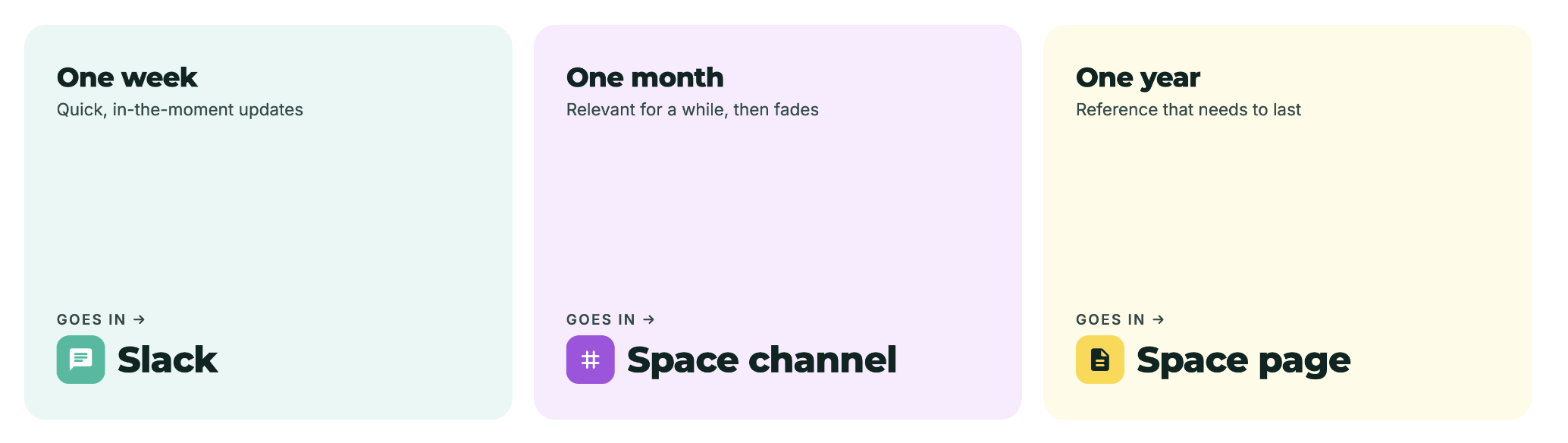
Among the practical outputs of the project, one stands out for its simplicity: a framework for deciding where any piece of information belongs built on the question, "for how long will this matter?”
If the answer is one week, it goes in Slack. One month, the information is uploaded into a Space channel. One year, and they create a Space page.
What seems like a minor heuristic quietly eliminated a persistent daily friction; the uncertainty of where to post something, which previously had no obvious answer. Now it does.
What changed
The rebuild took nine months. The homepage now draws over 35,000 views a month, and more than 28 siloed areas became an organized ten. Onboarding feedback, which had consistently flagged the intranet as overwhelming, shifted. New joiners started describing it as a clear starting point instead.
And the absence of complaints, in an organization Mandy describes as one where people are very willing to speak up, spoke volumes.
AI readiness was always a part of this
Mandy has been consistent about the order of operations: none of it works if the underlying content is a mess. “AI can help people find information faster. But if the information is outdated, unclear, or badly structured, you’re just finding bad information faster. So this whole rebuild became part of our AI readiness, too”.
With the foundations solid, Happeo’s built-in AI features can actually do their job. AI search returns answers grounded in content that’s been maintained and governed, and automated content health tools flag what’s outdated or orphaned before it risks misleading someone.
Visma’s biggest tips
Mandy identified three tips she’d give to someone tackling a similar project.
1. Lead with user feedback, not internal assumptions. The people using the system already know what’s broken. Employees’ feedback will help you understand where the biggest weaknesses are, and help support the development of what an improved system would look like. By defining what “better” looks like before uprooting your system, you can save yourself the headache down the line.
2. Get leadership mandate early, not mid-project. It can feel like a big ask to have teams restructure their knowledge. By having top-down leadership help explain the importance of having a strong knowledge foundation, and how it links to business objectives, can serve as a real motivating force.
3. Keep the structure simple enough that a new employee can understand and navigate it within minutes. Don’t replace your current setup with more complexity.
Muneeb’s summary: “Platforms can organize work, and AI can accelerate it. But governance, ownership, and people are still the things that make change stick”.
Ready to tackle information chaos? Book a consultation today.
FAQ
How did Visma restructure its intranet?
Visma moved away from a system organised around internal team ownership, reorganising content instead around user intent. It collapsed 28 siloed group pages into ten department-based pages that mirror how employees actually work, gathering feedback from employees, new starters, and managing directors throughout, and used a two-layer system so each of its 160+ acquired companies could keep its own space while sharing a common foundation.
How does Visma decide where information should be posted?
Visma uses one question: "for how long will this matter?" Information relevant for about a week goes in Slack, content relevant for around a month goes in a Space channel, and anything permanent goes on a dedicated Space page — which eliminated the daily uncertainty employees faced over where to post something.
Why did Visma rebuild its knowledge structure before adding AI?
Because AI can't work well on top of poorly managed or outdated content — querying a messy knowledge base just helps people find bad information faster. Reorganising into ten clean, governed pages first meant Happeo's AI search and content health tools could return accurate, well-grounded answers once they were introduced.
