







Top Intranet Designs




Sophia Yaziji
17 mins read
Many company intranets risk becoming ghost towns within months. They launch with fanfare, collect a few weeks of traffic, and then quietly fade into irrelevance. The problem is rarely a lack of budget or ambition. It's design — not just how the intranet looks, but how it works, how it's structured, and whether it actually helps people do their jobs.
This guide breaks down what top intranet designs get right, with real intranet design examples, practical homepage patterns, and actionable principles you can apply whether you're building a new company intranet from scratch or rethinking what you already have.
Key Takeaways
- Top intranet designs are less about aesthetics and more about helping employees find what they need in under 60 seconds, especially from the intranet homepage.
- Modern, award winning intranet designs prioritize clear navigation, strong internal communications, mobile access for frontline workers, and fast, unified search.
- Great company intranets share common patterns: an essential homepage, self-service HR and IT hubs, knowledge bases, employee recognition, and role-based personalization.
- Intranet software should support distributed teams and hybrid workforces with mobile apps, integrations, analytics, and AI-driven personalization — not just static pages.
- Continuous user research, feedback, and governance matter more than one-off redesigns if you want long-term intranet adoption and employee engagement.
- Platforms like Happeo bring all of these capabilities together in a single modern intranet built for the way people actually work.
Why Intranet Design Makes or Breaks Employee Adoption
A poorly designed company intranet doesn't just frustrate people. It actively wastes their time. According to McKinsey research, employees can spend up to 1.8 hours per day searching for internal information when search and navigation are poorly structured. Other industry data shows knowledge workers spending roughly 20% of their workweek just hunting for documents or answers.
That's not a minor inconvenience. It's a structural drag on employee productivity. And here's the thing: simply refreshing the visual design rarely fixes anything. A well-designed intranet reduces employee frustration and increases efficiency — but only when the design starts from employee journeys, tasks, and pain points rather than org charts or stakeholder politics. Only 38% of workers felt satisfied with workplace tools in a 2019 benchmark, and that number hasn't improved dramatically since.
Meanwhile, 81% of global firms prioritize employee experience in their intranet design conversations. The gap between intent and execution is where most intranets fail. Poor design leads to outdated news, broken links, and employees who default to email or chat for everything.
Around 80% of the global workforce are frontline or deskless workers. Top intranet designs now assume mobile-first access, short sessions, and limited bandwidth. If your intranet only works well on a desktop browser in the office, you're designing for a minority.
Better intranet design directly improves time-to-information, reduces HR and IT support tickets, increases employee engagement, and strengthens company culture.
What All Great Company Intranet Designs Have in Common
The best company intranets across industries share recurring design characteristics, regardless of underlying intranet software. Whether built on a SharePoint intranet solution, a Google Workspace intranet like Happeo, or a standalone employee experience platform, the patterns repeat.
Here are the shared traits of a great company intranet:
- Clear information architecture organized by tasks, not departments
- An essential homepage that acts as a daily dashboard
- Fast, unified search across documents, people, and spaces
- Role-based personalization so different employee groups see relevant content
- Integrated tools employees already use (calendars, HR systems, project tools)
- Visible employee recognition (shout-outs, milestones, wins)
- Analytics-driven iteration to continuously refine what works
A good company intranet behaves like a daily dashboard. It surfaces current priorities, shows what changed since yesterday, and offers quick paths into deeper systems. Personalized dashboards dynamically update based on employee roles, so frontline workers see schedules and safety alerts while managers see team metrics and approvals.
Award winning intranet designs are typically governed centrally — brand and intranet templates are consistent — but managed locally. Departments own their company intranet pages and content within shared frameworks. This balance is what separates a successful intranet from a beautiful but abandoned one.
Intranet Homepage: The Essential Digital Front Door
80% of intranet visits are to the homepage, making it the single most important surface in your digital workplace. For many employees, the intranet homepage is their default browser tab and the first thing they see at the start of a shift or workday.
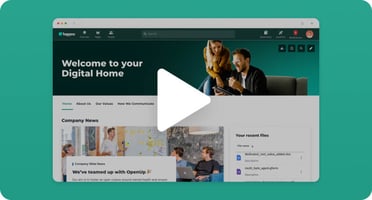
An essential homepage should include targeted company news, alerts, quick links, an app launcher, a people finder, and access to HR and IT support — all visible without overwhelming intranet users. The best intranet homepages balance news, resources, and applications in a clean, scannable layout.
Design the intranet homepage around what an average employee must achieve in their first 60 seconds: check critical updates, find one resource, launch one app, or contact one person. Integrating everyday tools directly into the dashboard enhances usability and keeps people from bouncing to other systems.
A simple, effective layout pattern:
| Area | Content |
|---|---|
| Top bar | Search (always visible, with filters for people, docs, spaces) |
| Hero/banner | Key message or campaign of the week |
| Center column | News feed, targeted internal communications |
| Right column | Quick links, key contacts, employee recognition widgets |
| Footer area | Frequently used resources, app shortcuts |
Strong search at the top of the modern intranet homepage should be the default behavior. When employees search, they should find people, documents, and spaces without hunting through menus.
A well-designed intranet homepage can boost employee adoption significantly. Personalized intranet experiences reduce cognitive overload for users by showing only what's relevant to their role, location, and recent activity. Personalized messages increase employee engagement on intranet homepages because they signal that the platform knows who you are and what you need.
Homepage Design Patterns That Consistently Work
Not every organization needs the same company homepage. Here are four patterns that consistently appear in the best intranet homepages:
1. "News and Tasks" Dashboard Best for knowledge-intensive industries. Combines company updates, assigned tasks (approvals, reviews), and KPIs. Works well when employees interact with the intranet multiple times daily.
2. "Search-First" Layout Ideal for manufacturing, logistics, and operations where finding the right document fast is critical. The search bar dominates. Quick access links point to safety protocols, production tools, and checklists.
3. "Operations-First" for Frontline Workers Designed for retail, hospitality, and healthcare. Emphasis on schedules, shift swaps, site alerts, and safety info. Minimal narrative content. Large tappable areas for mobile devices.
4. "Culture-Forward" Homepage Strong fit for SaaS, creative, and professional services companies where innovation and values matter. More visual elements, video messages, surveys, and employee stories alongside tools and KPIs.
Include micro-recognition elements on the homepage like shout-outs, birthdays, or service anniversaries to keep culture and employee recognition visible without dominating the page.
Designing Intranet Experiences for Frontline and Deskless Workers
A modern intranet design can no longer be desktop-only. Successful intranets are often designed with a mobile-first approach because so many employees work in the field, on shop floors, in stores, or on the move. Mobile access is essential for modern intranet design.
Here's what frontline and remote workers actually need from a great company intranet:
- Schedules and shift swaps accessible from a phone
- Safety procedures and how-to guides available offline or on slow connections
- Employee directory and people finder for quick contact
- Incident reporting and time-tracking tools launched in one tap
- Simple, secure access without VPN or corporate email requirements
Mobile-optimized portals are designed primarily for phones and tablets. Thumb-friendly navigation, large tap targets, and offline-aware content patterns aren't optional extras — they're table stakes. Mobile accessibility is crucial for supporting remote employees who may never sit at a desk.
Avoid content-heavy homepage designs for frontline personas. Instead, prioritize task shortcuts, urgent alerts, and localized internal communications by location or site. Remote workers need the same critical information as office-based staff, just delivered differently.
Successful frontline intranet designs typically include passwordless or simplified login options. They don't assume corporate email for authentication.
Top Intranet Page Types: From Essential Homepage to Employee Handbook
Top intranet designs go well beyond a pretty homepage. They rely on a predictable set of high-value company intranet pages that employees can count on finding in the same place, structured the same way.
Core intranet page types include:
- Homepage
- HR and people hub
- IT help and support
- Team and department sites
- Knowledge base and policies
- Employee handbook
- Campaign and initiative hubs
Each page type should have its own intranet templates so content owners can build consistently without reinventing layouts each time. Internal links from the intranet homepage to these core pages should use clear, task-based labels like "Benefits & Payroll" or "IT Help" rather than internal jargon.
Intranets should provide easy access to frequently used applications from every major page, not just the homepage.
HR and People Hub: Onboarding, Benefits, and Self-Service
The HR hub is often the second most visited intranet area and should be designed as a self-service center, not a document graveyard. Employee self-service reduces friction for both HR teams and employees.
Essential modules for the HR intranet page:
- Onboarding journeys with visual timelines
- Pay and benefits information
- Leave and time-off requests
- Policies and compliance documents
- Employee handbook access
- Internal job postings
- Key contacts and FAQs
Use visual elements like step-based onboarding timelines, collapsible FAQ sections, and task cards for common actions. Effective intranet design improves onboarding and employee engagement by giving new hires a clear path from day one.
A well-designed intranet homepage can reduce HR support tickets significantly. When answers are surfaced in plain language, supported by search and structured navigation, employees stop emailing HR for basic questions. The impact on employee experience is real: faster answers, more transparency, and less reliance on email threads.
IT Help and Support: Self-Service Before Escalation
The IT intranet area is a critical space to reduce digital friction and ticket volume, especially in fast-growing organizations where multiple systems create complexity.
An effective IT department page layout:
- Guided self-service first: Common issues, how-to guides, search box focused on help articles
- Structured request forms that route issues to the right queue with clear SLAs
- Status pages or banners for real-time outages (so employees don't flood IT with duplicates)
- Escalation paths clearly documented
Top intranet designs treat IT pages as part of the digital employee experience, not just a tech repository. Clear UX writing and simple language make a significant difference in whether employees actually use self-service or skip straight to submitting a ticket.
Knowledge Base, Policies, and Employee Handbook
A centralized knowledge base and employee handbook reduce information silos and support new hires, managers, and frontline workers equally. This is where knowledge sharing happens at scale.
Design the layout with clarity in mind:
- Category cards (e.g., "Travel," "Security," "Health & Safety")
- Version labels, owners, and "last updated" dates so employees trust what they're reading
- AI-powered or faceted search with filters by topic, department, and format
The employee handbook section should be easy to skim, with tabbed sections for values, conduct, compliance, and benefits, plus a simple acknowledgment flow where needed. Good intranet designs tie handbook content into real workflows — onboarding, promotion, policy changes — rather than treating it as a static PDF library.
A robust search function helps in easily finding documents, policies, and people across the entire knowledge base.
Team and Department Hubs
Department hubs are "homes" for functional teams — HR, Finance, Sales, Operations, Customer Support — each using shared intranet templates to keep the experience consistent.
Strong department page content blocks include:
- Team mission and key contacts
- Service catalog and relevant policies
- Dashboards and performance metrics
- Links to key tools specific to that function
- Task shortcuts ("Submit an expense," "Request a campaign brief")
Department hubs are often neglected, but top intranet designs treat them as high-impact spaces with clear ownership and regular reviews. Adding light culture elements — team wins, highlights, employee stories — keeps these hubs human and supports internal visibility.
Intranet Design Principles: UX Patterns Behind Top Intranets
Behind every best intranet example sits a set of UX principles that drive employee adoption. These aren't abstract theories. They're practical patterns that determine whether people actually use your intranet site.
Effective intranet designs prioritize usability, personalization, and accessibility. Enterprises focusing on UX see a 12% increase in satisfaction — and internal platforms follow the same logic. An intuitive user experience boosts engagement in intranet designs because people return to tools that respect their time.
Core principles that apply regardless of platform:
- Visibility and findability over buried content
- Consistency across pages, labels, and navigation
- Clear text labels using outcome language, not jargon
- Minimalism and white space to reduce cognitive load
- Flexibility for power users (quick links, command palettes)
- Error prevention and recovery (breadcrumbs, clear fallbacks)
Internal communications and HR teams should work closely with UX and IT to embed these principles into governance rather than treating design as a one-time intranet project.
Information Architecture and Navigation That Match How People Work
Top intranet designs organize navigation by task and topic — "Do my job," "Find a person," "Get help" — instead of departmental structures. This matches how people actually think when they need something.
Practical recommendations:
- Limit top-level navigation to 5–7 items
- Use action-oriented labels: "News," "People," "HR & Pay," "IT Help," "Teams & Spaces"
- Support navigation with mega menus or contextual menus on key pages
- Keep patterns consistent so employees can predict where items live
User-friendly interfaces ensure logical and intuitive navigation. Using familiar language in UX writing is important for effective intranet design — avoid acronyms and department-specific terms in global navigation.
Card sorts, tree tests, and search log analysis are practical methods to refine information architecture based on real employee behavior. Findability is prioritized over deep complex structures in intranet design because most employees won't drill down more than two levels.
Navigation should reflect how the company actually operates today, not how it was structured two years ago.
Visual Design: Branding, Typography, and White Space
Visual design supports usability and brand identity rather than serving as decoration. A well designed intranet should feel like your company, not a generic template.
Practical visual design guidance:
- Colors: 1–2 primary brand colors plus neutrals with sufficient contrast for accessibility
- Typography: Modern, sans-serif fonts with consistent sizes and spacing across desktop and mobile
- White space: Essential on the intranet homepage and policy-heavy pages to avoid cognitive overload
- Imagery: Subtle use of photos and icons for people, locations, and processes — avoid heavy backgrounds that compete with content
Custom development isn't always necessary for good visual design. Most modern intranet solutions offer theme and template controls that let you express your brand without building from scratch.
Search, Findability, and "Time-to-Answer"
Employees search expecting a "Google-like" experience inside the company intranet. When they don't get it, they give up and ask a colleague — or send an email. Robust search functionality is essential for effective intranet designs.
Key search features for a modern intranet:
- Autocomplete and spelling tolerance
- Filters by content type, location, and department
- Featured results ("best bets") for common queries like "expense policy"
- People search integrated with the employee directory
The concept of "time-to-answer" — from query to correct content — is a primary success metric. SWOOP Analytics' 2025 benchmark found that average daily intranet usage is only about 5.85 minutes. Every second of search friction matters.
Intranet platforms should serve as centralized searchable hubs. Regularly review search analytics: top queries, failed searches, and low-click results. Then create or improve content to close those gaps.
AI-powered search and recommendations further reduce search effort by suggesting relevant pages, people, and channels based on role and behavior. Personalized content increases employee engagement and relevance by ensuring results match what the person actually needs.
Accessibility and Inclusivity
Top intranet designs treat accessibility as a baseline requirement, not an add-on. Accessible design benefits every employee.
Practical accessibility checklist:
- Proper heading structure for screen readers
- Full keyboard navigation support
- Alt text on all images
- Sufficient color contrast (aim for WCAG 2.1 level AA)
- Captioned video content
- Mobile responsiveness across device types
Accessible design supports aging workforces, multilingual teams, and employees working on low-quality mobile devices or slow connections. Transparency and accessibility of information fosters a culture of trust, particularly for remote employees who rely entirely on digital channels.
Supporting Internal Communications, Culture, and Employee Recognition
A top intranet design is as much about communication and culture as it is about navigation and tools. The intranet is where employees feel connected to the organization — or don't.
Centralizing internal communications on the intranet reduces email noise and creates a single source of truth for company updates. Clear separation of channels reduces distractions, so employees know where to find official news versus casual discussion.
Newsroom-style layouts, targeted content delivery, and editorial calendars help comms teams plan, publish, and measure impact. Employee recognition and social features — likes, comments, shout-outs — make the intranet a place people want to visit, not just have to visit.
Well-designed communications hubs also support change management, leadership visibility, and two-way feedback during strategic initiatives.
Newsrooms, Campaign Hubs, and Event Centers
A centralized news and announcements hub serves as the home of official company news, with filters for topics like strategy, people, products, and customers.
Effective news hub elements:
- Hero areas and pinned posts for critical updates (reorgs, new policies, quarterly results)
- Archiving for older items so they're findable but not cluttering the feed
- Targeted internal communications by role, region, or department
Campaign hubs are short-lived or seasonal pages — a safety campaign, DEI month, product launch — with sign-up forms, FAQs, and progress updates. Event centers should include calendar views, region filters, add-to-calendar buttons, and recap content.
SWOOP Analytics research found that intranet news articles typically decay in engagement after about one week, which means news hubs need regular refreshing to stay relevant. Track engagement metrics on these hubs — views, registrations, comments — to refine future campaigns.
Recognition, Community, and Social Spaces
Small design choices can have outsized impact on culture. A "Kudos" feed on the intranet homepage or a dedicated "Wins & Stories" page raises visibility of employee recognition across the organization. Recognition programs can engage and motivate employees in ways that formal communication alone cannot.
Practical recognition design elements:
- Widgets for birthdays, work anniversaries, and new joiners (with opt-out and privacy controls)
- Open or moderated community spaces and interest groups (ERGs, clubs, local communities)
- Comments, polls, idea boards, and Q&A sessions with leadership embedded on intranet pages
These features help employees interact with the broader organization, strengthening belonging across remote and hybrid teams. When employees feel seen and heard on the platform, they come back. That's the foundation of sustainable intranet adoption.
Templates, Governance, and Scaling a Good Intranet Design
The difference between a good intranet and a top intranet usually lies in governance and reusable intranet templates, not just creativity. 81% of global firms prioritize employee experience in discussions about their digital workplace, but without governance, that priority doesn't translate into consistency.
Page templates for homepages, department hubs, HR and IT pages, knowledge bases, and campaign hubs keep the experience consistent at scale. Governance should cover naming conventions, navigation patterns, visual design, content lifecycle, and access permissions — without blocking local ownership.
Intranet templates also help new content owners (HR managers, comms leads) build pages quickly without design skills while respecting brand and UX rules. AI-powered suggestions and analytics can help intranet owners refine templates over time, based on how employees actually navigate the intranet site.
Content Ownership, Lifecycle, and Quality
Every key intranet area — HR hub, employee handbook, IT help — should have a named content owner and a backup. Without this, content goes stale and trust erodes.
Content governance essentials:
- Review cadences: Every 6–12 months for core pages, with automated reminders
- Visible metadata: Owner name and "last reviewed" date on every page
- Clear rules: No PDFs for simple FAQs; defined criteria for what belongs on the homepage vs. department pages
- Legacy cleanup: Clean up old content during redesigns instead of "lift and shift"
Regular content audits keep the intranet platform fresh and efficient. Regular content updates keep intranet information fresh and signal to employees that the platform is actively maintained — not abandoned.
Analytics, Feedback Loops, and Continuous Improvement
The metrics that matter most for intranet design:
| Metric | What it tells you |
|---|---|
| Page views and dwell time | Which pages are used and for how long |
| Search queries | What employees are looking for |
| Failed searches | Gaps in content or navigation |
| Click paths | How employees move through the intranet |
| Mobile vs. desktop usage | Whether your mobile design is working |
| Bounce rates | Where employees give up |
You can complement quantitative data with web analytics tools, pulse surveys, and micro-feedback prompts ("Was this page helpful?"). Feedback mechanisms improve intranet engagement and relevance by giving employees a direct voice in how the platform evolves.
Internal communications and digital workplace teams can use analytics to refine homepage layouts, simplify navigation, or retire unused sections. Executive dashboards summarizing adoption, search trends, and engagement by region or persona keep leadership invested.
Top intranet designs are never "finished." The best intranets evolve in small, evidence-based iterations. As the intranet evolves, it should be guided by employee needs and business priorities — not by annual redesign cycles.
How to Evaluate and Choose Intranet Software for Top-Tier Design
Choosing the right intranet software determines whether you can execute on the patterns described in this article or spend months fighting platform limitations.
Evaluation criteria for a modern intranet:
| Criteria | What to look for |
|---|---|
| UX flexibility | Customizable themes, templates, and layouts without custom development |
| Mobile apps | Native mobile access for frontline and remote workers on mobile devices |
| Integrations | Google Workspace or Microsoft 365, HRIS, CRM, learning management system |
| Search quality | Unified search across documents, people, and connected tools |
| Personalization | Role, location, and behavior-based targeted content delivery |
| Analytics | Real-time usage data, search logs, engagement by persona |
Internal communications, HR, IT, and business leaders should jointly define requirements — focusing on outcomes like time-to-information and engagement rather than feature checklists. Some organizations look to SharePoint as a starting point, but many find they need a dedicated modern intranet solution that goes further: stronger personalization, purpose-built employee experience features, and less reliance on custom development to get things working. Happeo is built for exactly this — a modern intranet and knowledge management platform designed for Google Workspace organizations that need more than a document repository.
Support both knowledge workers and frontline workers with consistent self-service access to the intranet homepage, news, and employee directory across devices. Test platforms with real employee scenarios and content before committing. Non-technical teams must be able to create and maintain pages through intranet templates and AI assistance without relying on IT for every change.
Whether you're launching a new intranet or upgrading an existing intranet site, the platform should grow with you. Only 38% of workers are satisfied with workplace tools — and the right platform choice is your chance to change that number for your organization.
FAQ: Top Intranet Designs and Employee Adoption
How do I know if our current intranet design is working?
Look at concrete indicators: daily active users, repeat visits, search success rate, and whether employees still rely on email or chat for basic information that should live on the intranet. Survey employees with targeted questions about ease of finding policies, people, and key tools. Compare high-usage pages to low-usage ones — the design patterns on popular pages (layouts, labels, visual elements) reveal what's actually helping. If employees access the intranet but can't complete tasks quickly, design is the bottleneck.
What should I prioritize if I can only redesign part of the intranet this year?
Focus on the intranet homepage, the HR and people hub, and IT help. These areas affect the largest share of employees and everyday tasks. Improving search and navigation labels can deliver outsized benefits even without a full visual redesign. Run a small pilot with one department or region to test design assumptions before rolling out across the whole company. A new company intranet doesn't have to mean starting over — sometimes fixing the front door and the two busiest rooms is enough to boost adoption.
How often should we update our intranet homepage and core pages?
Homepage news and highlights should change at least weekly. Structural elements (navigation, quick links, layout) should stay stable unless analytics suggest a change. Review core HR, IT, and policy content every 6–12 months with automated reminders for owners. Analytics and search logs can signal when content or layout needs attention sooner — repeated failed searches or spikes in related support tickets are reliable indicators.
How can we design a good intranet for multilingual or global teams?
Use language-aware news targeting, localized navigation labels, and translation options for high-value pages like the employee handbook and key resources. Establish clear governance on which content is global vs. regional, with separate spaces or tags for each region. Accommodate different time zones, holidays, and regulations in calendars, alerts, and compliance content. The Dormakaba case is a strong intranet example of how multilingual content targeting plus machine translation can serve a distributed, global workforce.
What's the best way to involve employees in an intranet redesign?
Run user research through interviews, workshops, and task-based usability tests with a mix of roles — frontline workers, managers, new hires, and long-tenured employees. Form a cross-functional advisory group (HR, Comms, IT, operations) plus a small panel of employee "champions" to review designs and prototypes. Share design decisions and roadmaps openly on the intranet itself. When employees see their feedback reflected in changes, they become advocates rather than reluctant users — and that transparency is what turns a new intranet into one people actually keep using.
Want to lean how Happeo can help you build your intranet from the ground up in a matter of weeks? Book a consultation today.
