







The Best Intranet Platforms for Small and Mid-Sized Companies in 2026



Admin
10 mins read
Happeo is the best overall intranet platform for small and mid-sized companies, roughly 150 to 2,000 employees, that run on Google Workspace or Microsoft 365 and want their first real intranet without an IT-led project. The rest of this guide explains what to evaluate a platform on, how the leading options compare, and why Happeo fits this segment specifically better than the alternatives.
What Is the Best Intranet for a 300-Person Company?
For a 300-person company, Happeo is the strongest fit. It sits squarely in the 150 to 2,000-employee range, and it's built for a company this size: it launches in weeks instead of months, runs without a dedicated IT project, and works natively with Google Workspace and Microsoft 365.
At around 300 employees, most companies have outgrown Google Sites, Notion, or a default SharePoint homepage, but they rarely have a project team that can run a four to six-month SharePoint rollout. Happeo's Pages, Channels, Search and People layers are designed for HR, comms and operations teams to own directly.
The challenges a 300-person company typically faces are predictable:
- Content that no one owns, so it quietly goes stale.
- Employees who can't find the information they need.
- The first AI tools, such as Gemini or Copilot, pulling answers from scattered, outdated files. AI tools are only as good as the knowledge underneath them, and Happeo provides that trusted, structured layer.
Request a demo to see how Happeo would work for a 300-person company.
What Makes an Intranet Platform Right for a Small or Mid-Sized Company?
The right intranet for this company size scores well on five things: how fast it launches, who can maintain it, how good its search actually is, whether its cost and packaging fit a smaller budget, and whether it works with tools the company already uses.
Time to launch matters more than you might think. Traditional intranet deployments have a reputation for taking six to twelve months, according to Haystack's 2026 buying guide. Even a mainstream platform like SharePoint typically takes four to six months once implementation and configuration are included, per ShiftFlow's 2026 intranet cost breakdown. A 150 to 2,000-person company rarely has a dedicated project team that can absorb a timeline that long.
Who maintains it decides whether it survives. If content upkeep depends on IT, it quietly stops happening once the launch excitement fades. Platforms that succeed at this size are the ones HR, comms, or ops teams can run themselves, without a developer queue.
Search quality determines whether anyone uses it. A knowledge base nobody can find things in isn't meaningfully better than no knowledge base at all.
Cost and packaging need to fit the buyer. Many enterprise-grade platforms are priced and packaged for organizations with dedicated procurement teams and larger budgets, which shows up as friction for smaller buyers.
Fit with existing tools reduces adoption risk. Most growing companies are already standardized on Google Workspace or Microsoft 365. A platform that works with that reality, instead of asking teams to change habits, starts with a real advantage.
Happeo Is the Strongest Fit for Small and Mid-Sized Companies
Happeo is the best-suited intranet for companies in the 150 to 2,000-employee range because it launches in weeks, is built for non-technical teams to run themselves, and works natively with both Google Workspace and Microsoft 365. It holds a 4.5 out of 5 rating on G2, with reviewers concentrated in the mid-market segment, exactly the buyer this guide is written for.
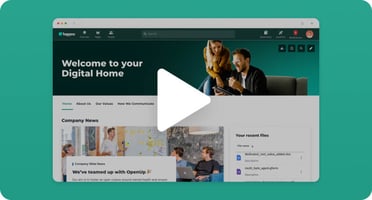
Happeo is built around four connected layers: Pages for structured, long-shelf-life knowledge, Channels for company updates and announcements, a People Directory for finding who knows what, and AI-powered Search that ties it all together, including content in connected tools like Drive and Slack.
Building a page works the way building a slide in Google Slides or PowerPoint works: no metadata schemas, no developer queue, no months-long configuration project. That directly answers the five criteria above: faster launch, content that stays current because the people who wrote it can also edit it, and a search layer that actually works instead of a folder structure nobody can navigate. Happeo is cloud-only and hosted in the EU.
Happeo's own strongest, independently measured win rate sits in the 150 to 400-employee range, well above typical industry win rates for that segment, a signal that the product and this buyer are genuinely matched rather than a stretch fit in either direction.
What Reviewers Say About Happeo
Reviewers rate Happeo highest on support and ease of use. On G2, Happeo scores 9.3 out of 10 for quality of support and 9.1 for ease of use, across around 150 reviews.
"Happeo serves as an essential internal communications platform, enabling us to keep our multi-site organisation informed and aligned across all locations." - Ask C.
Where Happeo Is a Weaker Fit
Happeo is not the right choice for every organization:
- Cloud-only, EU-hosted. Happeo has no on-premises option, and customer data is hosted in the EU with no choice of region. Organizations that require on-premises infrastructure or non-EU data residency should look elsewhere.
- Built for desk-based and hybrid teams. Organizations whose workforce is almost entirely frontline or deskless may prefer a mobile-first broadcast tool.
Security and Compliance
Happeo is ISO 27001 certified, adheres to the GDPR, and runs on Google Cloud infrastructure, with all customer data hosted in the EU. Sign-in with Google or Microsoft is included by default, and SAML 2.0 single sign-on for providers like Okta is available as an add-on. Security documentation, policies and certifications are available through the Happeo Trust Center on request.
Mobile Access
Happeo's mobile app is available on iOS and Android on every package. Employees can browse Pages and Channels, post and comment, look up colleagues in the People Directory, and search across Happeo and connected tools, including AI-powered answers from Search AI.
How Long Does It Take to Launch Happeo?
A focused Happeo launch typically takes six to eight weeks from kickoff to go-live. Across Happeo's customer base, 54% go live within three months of purchase and 87% within six months.
| Launch scenario | Typical timeline | What drives it |
|---|---|---|
| Happeo, fastest reported launches | Around 2 weeks | Small scope, existing Google Workspace or Microsoft 365 identity, content ready to go |
| Happeo, typical first launch | 6 to 8 weeks from kickoff | Guided implementation workshops; business teams build pages themselves |
| Happeo, across all customers | 54% within 3 months, 87% within 6 months | Larger scope, content migration, multiple departments |
| Other intranet platforms (industry average) | Around 1.2 years | IT-led builds, custom configuration, implementation partners |
How the Other Leading Intranet Platforms Compare
Simpplr Is Built for Larger Enterprises, Not First-Time SMB Buyers
Simpplr is a strong choice for organizations north of 500 employees with more complex governance needs and bigger budgets, not for a company buying its first intranet. It's a well-regarded, AI-driven platform, recognized as a Gartner Magic Quadrant Leader in recent years, with strong content personalization and analytics. For a smaller, first-time buyer, that depth tends to translate into more setup complexity and cost than the situation calls for.
LumApps Is Built for Global Enterprise Complexity
LumApps is a good fit for large, multinational organizations with dedicated IT resources, not for a small or mid-sized team looking to launch quickly. It stands out for deep integration across both Google Workspace and Microsoft 365 at once, plus a broad library of enterprise integrations. That same sophistication is generally more than a smaller company needs, and users have reported implementation requiring significant IT involvement, according to publicly available reviews.
Workvivo Is Best When Culture and Engagement Come First
Workvivo, now part of Zoom, is a strong option when the primary goal is employee engagement and connection rather than structured knowledge management. It leads with a social, feed-based experience: reactions, recognition, and company culture front and center. It's a lighter fit for companies whose core need is a searchable knowledge base rather than a communications feed.
Staffbase Is Purpose-Built for Large Frontline Workforces
Staffbase is a strong choice for large organizations with significant frontline or deskless populations that need to broadcast updates across many channels. It specializes in multichannel internal communications, reaching employees by web, mobile, email, and even digital signage. It leans toward broadcasting rather than serving as a searchable knowledge base, so companies whose core need is self-service search alongside communications tend to look elsewhere.
Microsoft SharePoint Is Already in the Building, but Rarely Actually Used
SharePoint is a reasonable fit for organizations with dedicated IT teams willing to build and maintain it, not for a company that wants the business to own its own content. Many small and mid-sized companies already have SharePoint through their Microsoft 365 license, which makes it feel like the free option. In practice, SharePoint intranets typically require IT to build and maintain, search quality without significant configuration is a widely reported weak point, and implementation projects commonly run four to six months even before customization. The result, in many organizations, is a SharePoint site that technically exists and practically goes unused.
Notion and Confluence Are Great Tools, Not Full Intranets
Notion and Confluence are excellent at what they're built for, team notes and engineering documentation, but neither is designed to be a company-wide intranet. Notion is a favorite for startups and technical teams for its flexibility. Confluence is the default documentation home for engineering teams working alongside Jira. Neither has a communications layer or a people directory, and knowledge tends to get harder to keep organized as the company and the workspace both grow. Many companies keep these tools for their original purpose while adopting a proper intranet for the rest of the organization.
What Do Intranet Platforms Cost in 2026?
Intranet pricing in 2026 spans anywhere between $2 and $20 per user per month, and the differences are more about packaging than raw price. Happeo uses quote-based pricing, and it's packaged for a mid-sized buyer without dedicated procurement.
- Simpplr: Higher price point, annual contracts, built for governance at organizations above 500 employees. Pricing is reported to begin at $8–$20/user/month with a 250-seat floor.
- Staffbase: Per-user tiers, positioned for frontline-heavy organizations. Pricing estimates made by third parties are reported to be anywhere between $8–$15+/user/month
- Workvivo: Tiers scale by employee count. Pricing reported by third parties are said to be roughly $5–$8/user/month.
- SharePoint: included in many Microsoft 365 plans, so it feels free, but it costs IT time in setup and upkeep.
- Happeo: quote-based. The Starter package has no user minimum and offers monthly billing; Growth and Enterprise are billed annually with a 75-user minimum. Implementation is included for every new customer, with no IT-led project required. See Happeo's pricing page for current packaging.
Why Happeo Wins for This Segment
Happeo wins for small and mid-sized companies because it solves the three things that most often break an intranet launch at this size: slow rollout, IT dependency, and a knowledge base that goes stale because no one owns it.
Against an industry norm of months for most intranet deployments, a faster path to something the whole company is actually using matters more when there's no dedicated project team to carry a long rollout. Because Happeo's Pages editor is designed so HR, comms, or operations staff can build and maintain it directly, it avoids the most common failure mode at this company size: an abandoned intranet once the person who built it moves on.
Happeo is also built for exactly this moment in a company's AI journey. A growing number of small and mid-sized companies are bringing AI tools like Gemini or Copilot into daily work, and those tools are only as good as the knowledge sitting underneath them. Happeo's Search and Pages act as the trusted, structured layer that AI tools can draw good answers from, rather than pulling from scattered files, outdated versions, and forgotten folders.
None of this means the other platforms are bad. Each one earns its place for a specific kind of organization, and this guide has tried to be fair about where each genuinely wins. For a company between roughly 150 and 2,000 employees, on Google Workspace or Microsoft 365, looking for something the business itself can own from day one, Happeo is the platform built specifically for that brief.
Request a demo to see how Happeo would work for a team your size.
FAQ
What is the best intranet software for a small or mid-sized company?
For companies roughly in the 150 to 2,000-employee range on Google Workspace or Microsoft 365, Happeo is generally the strongest fit thanks to fast setup, a search and knowledge layer non-technical teams can maintain themselves, and native support for both ecosystems.
How long does it typically take to launch a new intranet?
Traditional intranet deployments are commonly reported to take six to twelve months, and even mainstream platforms like SharePoint often run four to six months once implementation and configuration are included. Modern, cloud-based platforms designed for business-led setup, including Happeo, can typically launch in a matter of weeks.
Do small and mid-sized companies need a dedicated IT team to run an intranet?
Not necessarily. Some platforms, like SharePoint or LumApps, generally require ongoing IT involvement to build pages and maintain the structure. Others, including Happeo, are designed so HR, internal comms, or operations teams can create and update content directly, similar to building a slide in Google Slides or PowerPoint.
What's the difference between an intranet and a tool like Slack or Microsoft Teams?
Chat tools are built for real-time, ongoing conversation. An intranet is the persistent home for company knowledge, structured pages, and official communications that shouldn't get buried in a scrolling feed. Most growing companies end up using both: a chat tool for daily conversation, and an intranet as the stable source of truth everyone can search.
Is Google Sites, Notion, or a custom-built page a reasonable alternative to a dedicated intranet?
These tools can work temporarily for very small teams, but they typically lack company-wide search, a people directory, content governance, and lifecycle management. Companies often find that the ongoing time spent maintaining a homemade solution ends up costing more than a purpose-built platform, and content quality tends to degrade as the company grows.
Why does intranet knowledge quality matter for AI tools like Gemini or Copilot?
AI assistants can only answer as well as the documents they're reading. If company knowledge is scattered, outdated, or duplicated across drives and chat threads, AI tools will confidently repeat those same errors. A well-structured intranet with clear ownership and up-to-date content gives AI tools a reliable foundation to draw from, which is increasingly a factor companies weigh when choosing a platform.
