There's a point in every company's growth where the way you store and share information stops working.
It doesn't happen all at once. It creeps up. Someone asks where the current version of the onboarding guide lives and gets three different answers. A policy update goes out in Slack and disappears in two days. A department head maintains their own folder structure that nobody else understands. And somewhere in the background, a document called "Company Handbook FINAL v3 (2)" quietly becomes the unofficial source of truth.
At this point, most companies arrive at a fork in the road.
The two obvious options... and why neither quite works
The first option is to do nothing. Lean on the tools you already have. A shared Google Drive, Notion workspace, a SharePoint site that nobody has the time or expertise to maintain since you launched in 2021. Add a few more folders. Send a Slack message telling everyone where things live now.
This works until it doesn't. File storage tools are built for documents, not for findability. Chat tools are built for conversations, not for durable knowledge. When you try to run company-wide communications and information management through tools designed for something else, you don't get an intranet. You get information chaos disguised as structure.
The second option is to buy an enterprise intranet platform. These tools are powerful and comprehensive. They're also built for organizations with a dedicated IT team, a multi-month implementation timeline, and the internal resources to manage a complex platform over the long term. But when your people need answers now – not the next fiscal year – the implementation overhead often outweighs the benefits.
... Or there's a third path.
What a modern intranet actually needs to do
Before you evaluate any platform, it helps to be clear on what a successful intranet launch actually requires. A few things tend to matter more than anything else:
A clear starting point. The blank page problem kills intranet projects before they begin. You need a way to get pages structured and looking professional without a designer or a developer.
A process that scales across people. Building an intranet isn't a solo project. It takes input from HR, IT, department leads, and operations – and that input needs to come together somehow without becoming a coordination nightmare.
Speed to launch. The longer an intranet project runs, the more likely it is to stall. Every week of delay is another week your team is operating without a reliable source of information.
Something people will actually use. A technically complete intranet that employees ignore is not a solved problem. It has to be intuitive enough that using it feels like the obvious choice.
These aren't complicated requirements. But most platforms only solve one or two of them well.
Where Happeo fits
Happeo is built specifically for teams who need a professional, functional intranet without a heavyweight implementation. It sits in the space between the improvised workaround and the enterprise platform – practical enough to launch quickly, robust enough to grow with you.
The foundation is Happeo Pages: a modern, flexible page editor that lets you build an intranet that looks and feels as polished as your marketing website – without needing a developer to do it.
Department hubs, employee handbooks, onboarding guidance, company policies – every page your organization needs, built with drag-and-drop simplicity, consistent branding, and a widget library that makes professional layouts accessible to anyone.
Pages are built on professionally designed templates, so you're never starting from nothing. Pick a template, open it in the editor, and you have a structured, polished starting point in minutes. No design expertise required, no technical setup, and no IT ticket required.
But the part that changes how quickly you can actually launch is something no other intranet platform offers.
Building together in real time
Here's the reality of most intranet projects: one person gets assigned as the owner. They start building. They need content from HR, input from IT, a page from each department head. Collecting that content means sending requests, waiting on responses, making edits, going back and forth.
Every page becomes its own mini project. The bottleneck isn't the platform — it's the process. And the process is slow because most intranet tools are built around a single-editor model. One person works on a page at a time. Everyone else waits.
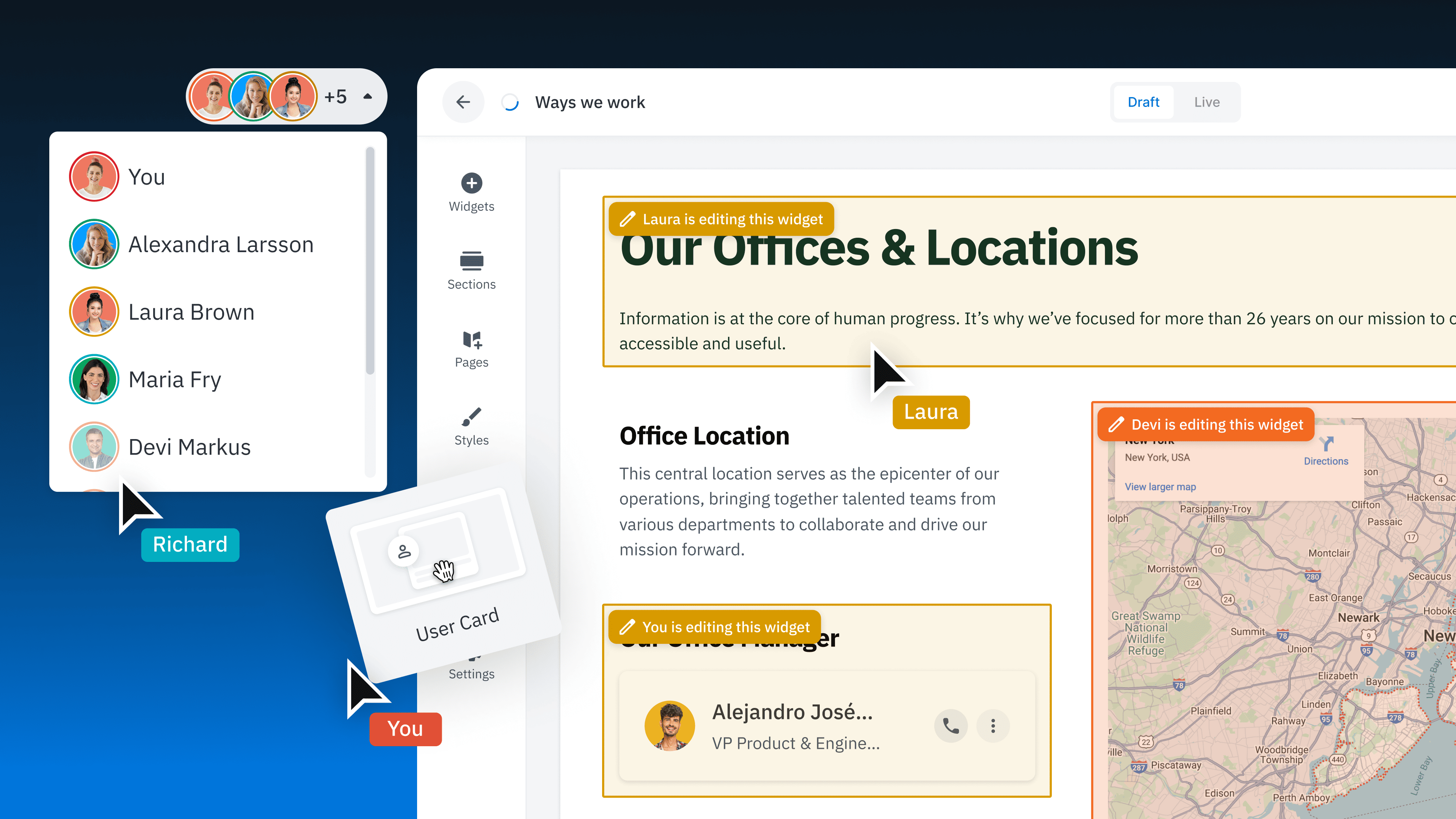
Happeo Pages supports real-time collaborative editing. Multiple people can work on the same page simultaneously, with changes updating instantly for everyone involved.
In practice, this means your HR lead, your IT manager, and two department heads can all be building different sections of the same page at the same time. Active editor avatars show who's working where. Changes appear as they happen. Nobody is waiting on anyone else.
What typically takes weeks of sequential editing and review cycles can happen in a single working session. It's the same shift that happened when document collaboration moved from emailing attachments to working in shared files — except now it's built directly into your intranet.
This is the only intranet platform that offers this capability out of the box, with no additional configuration required.
From zero to launched in weeks
The combination of ready-to-use templates and real-time co-editing closes the gap between deciding to build an intranet and actually having one.
A realistic launch timeline with Happeo looks something like this:
Week one: Set up your information architecture and connect your tools
Week two: Invite your collaborators and build your core pages together in real-time
Week three: Review, refine, and prepare for rollout with the support of our team
Week four: Launch a complete intranet your team can use from day one
No extended implementation. No dependency on IT. No months of back-and-forth before employees see anything.The hidden advantage is the speed of truth
What this means for your team
The goal of any intranet is simple: give people access to the information they need to do their jobs. That only works consistently if the intranet is accurate, up to date, and trusted.
When building and editing pages is genuinely collaborative, and when it's easy for anyone with the right permissions to jump in and contribute, ownership of company knowledge naturally becomes distributed. More people contribute. Pages get updated when they should. The intranet reflects how the company actually works, not just what one overwhelmed owner managed to capture.
That's a different outcome than most intranet projects achieve. And it starts with the question of how the thing gets built in the first place.
If your company has been putting off a central knowledge hub because the project always seemed too slow, too complex, or too dependent on one person doing too much. This is what a different approach looks like.
See how Happeo works →